Tensile Strength Tester Testing Guide for Indian Manufacturers: Procedure, Results & Common Errors
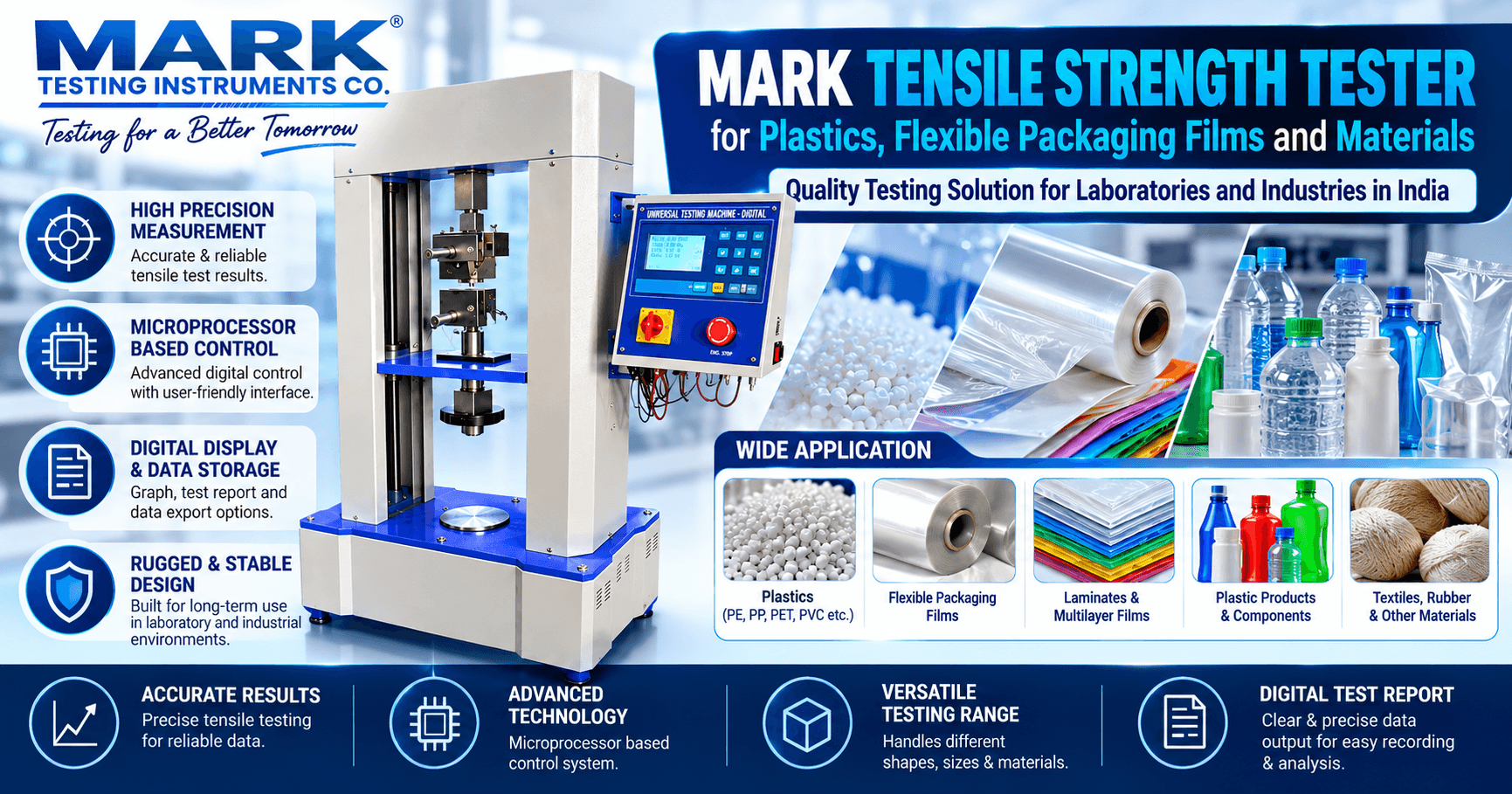
Learn how to perform tensile strength testing for plastics and packaging films in Indian quality-control laboratories. Explore ASTM D882 and ASTM D638 procedures, tensile strength calculations, elongation results, common testing errors and MARK Digital, Computerized and HMI Tensile Tester configurations.
Tensile Strength Tester Testing Guide for Indian Manufacturers: Procedure, Results & Common Errors
Tensile strength testing is an important quality-control process for manufacturers of plastic products, flexible packaging films, polymer materials and other suitable industrial materials.
A Tensile Strength Tester measures the response of a material when subjected to a controlled pulling force.
The test helps determine tensile strength, elongation and other mechanical properties according to the selected test method.
For Indian manufacturers, reliable tensile testing supports incoming-material inspection, product development, manufacturing quality control and customer specification verification.
MARK Testing Instruments offers Digital, Computerized and HMI Touchscreen Tensile Strength Testing Machines for different laboratory requirements.
This guide explains the tensile testing procedure, result calculations, applicable standards, common errors and important equipment selection considerations.
What Is a Tensile Strength Tester?
A Tensile Strength Tester is a laboratory instrument designed to apply controlled tensile loading to a prepared specimen.
The specimen is held between suitable grips and pulled at a specified testing speed.
The instrument measures the applied force and, depending on configuration, displacement or strain.
Tensile testing can provide information such as:
- Maximum tensile force
- Tensile strength
- Elongation at break
- Elongation at maximum force
- Yield behaviour, where applicable
- Force-versus-displacement behaviour
- Stress-versus-strain behaviour, when the necessary measurements are available
The reported properties depend on the material, specimen geometry, measurement system and selected testing standard.
Why Tensile Strength Testing Is Important
Tensile testing helps manufacturers evaluate the mechanical behaviour of materials under pulling forces.
Main Benefits
- Verification of raw-material quality
- Comparison of material grades
- Monitoring production consistency
- Evaluation of product development changes
- Investigation of material failures
- Verification of customer specifications
- Support for laboratory quality documentation
- Comparison of manufacturing batches
For packaging film manufacturers, tensile testing can help evaluate strength and elongation characteristics in the machine direction and transverse direction.
Materials Tested Using a Tensile Strength Tester
Depending on grips, capacity and applicable standards, tensile testing equipment can be used for:
Plastic Materials
- Plastic sheets
- Injection-moulded specimens
- Extruded plastic specimens
- Polymer components
Flexible Packaging Films
- Polyethylene films
- Polypropylene films
- Flexible plastic sheets
- Suitable laminated films
Rubber and Elastomers
Rubber tensile testing requires suitable grips, strain measurement and the appropriate material-specific test method.
Paper and Textile Materials
Paper, yarn and textile testing require appropriate specimen preparation, grips and applicable standards.
Important: ASTM D882 and ASTM D638 should not be used as universal standards for paper, textile and rubber materials.
Tensile Strength Testing Standards
ASTM D882 — Thin Plastic Sheeting
ASTM D882 is used for determining tensile properties of thin plastic sheeting.
It is commonly relevant to flexible plastic films and thin sheets within the method's scope.
ASTM D638 — Plastics
ASTM D638 is used for determining tensile properties of plastics.
It is commonly applied to suitable plastic specimens prepared according to the standard.
Other Material Standards
Other materials may require additional standards, such as:
- ASTM D412 for suitable rubber and elastomer materials
- ISO 1924 series for applicable paper tensile testing
- ISO 13934 series for certain textile fabric tensile tests
The correct standard must be selected according to the material and testing objective.
Step-by-Step Tensile Strength Testing Procedure
Step 1: Identify the Material and Standard
Determine the material type and the required testing method.
For example:
- Thin plastic films: ASTM D882, where applicable
- Plastic moulded specimens: ASTM D638, where applicable
The standard determines specimen geometry, conditioning and testing requirements.
Step 2: Prepare the Test Specimen
Prepare specimens according to the selected method.
Check:
- Specimen dimensions
- Edge condition
- Thickness
- Width
- Gauge length
- Surface condition
- Visible damage
Improper specimen preparation can cause premature failure or inconsistent results.
Step 3: Condition the Specimen
Condition the material according to the selected standard.
Temperature and humidity may influence material properties.
Step 4: Inspect the Testing Machine
Before testing, check:
- Load cell
- Specimen grips
- Crosshead movement
- Calibration status
- Safety functions
- Software or display
- Measurement units
Step 5: Select the Required Test Parameters
Enter or confirm:
- Test standard
- Specimen dimensions
- Gauge length
- Testing speed
- Load range
- Measurement units
- Result calculations
Step 6: Mount the Specimen
Position the specimen between the grips.
Ensure proper alignment and sufficient gripping force.
Avoid excessive clamping that may damage the specimen.
Step 7: Start the Test
Start the tensile test.
The machine applies tensile loading according to the selected test conditions.
Step 8: Observe Material Behaviour
Depending on the instrument configuration, monitor:
- Applied force
- Crosshead displacement
- Specimen extension
- Force-versus-displacement graph
- Stress-versus-strain graph
Step 9: Record the Results
Record the required values according to the selected standard.
Step 10: Review the Test Report
Check the results for:
- Specimen failure location
- Grip slippage
- Unusual load behaviour
- Test interruptions
- Incorrect specimen dimensions
- Inconsistent results
Repeat testing where required by the standard or laboratory procedure.
How to Calculate Tensile Strength
Engineering tensile strength is commonly calculated using:
Tensile Strength = Force / Original Cross-Sectional Area
For a rectangular specimen:
Original Area = Width × Thickness
For example:
- Maximum Force = 250 N
- Specimen Width = 10 mm
- Specimen Thickness = 0.5 mm
Original Area:
10 × 0.5 = 5 mm²
Tensile Strength:
250 / 5 = 50 N/mm²
Therefore:
Tensile Strength = 50 MPa
This is an illustrative calculation. Actual reporting must follow the selected standard.
How to Calculate Elongation
Engineering elongation percentage can be expressed as:
Elongation (%) = [(Final Gauge Length − Original Gauge Length) / Original Gauge Length] × 100
Example:
- Original Gauge Length = 50 mm
- Final Gauge Length = 125 mm
Elongation:
[(125 − 50) / 50] × 100 = 150%
Elongation = 150%
The extension measurement method must be appropriate to the material and standard.
Crosshead travel should not automatically be treated as specimen strain.
Understanding Tensile Test Results
Maximum Force
The highest measured tensile force during the test.
Tensile Strength
The tensile force divided by the appropriate original cross-sectional area.
Elongation at Break
The specimen extension at rupture, expressed according to the selected method.
Yield Strength
A tensile stress associated with yielding, where the material and method support its determination.
Force-versus-Displacement Graph
Shows the relationship between applied force and measured displacement.
Stress-versus-Strain Graph
Shows the relationship between engineering stress and measured strain when suitable measurements are available.
Common Tensile Testing Errors
1. Specimen Slippage
Possible Causes
- Insufficient gripping force
- Incorrect grip type
- Unsuitable specimen surface
Corrective Actions
- Select appropriate grips
- Adjust clamping
- Inspect the specimen mounting
2. Specimen Breakage Near the Grip
Possible Causes
- Excessive gripping pressure
- Misalignment
- Damaged specimen edges
Corrective Actions
- Check alignment
- Use suitable grip faces
- Improve specimen preparation
3. Inconsistent Test Results
Possible Causes
- Variation in specimen dimensions
- Incorrect conditioning
- Testing speed differences
- Material variability
Corrective Actions
- Standardize specimen preparation
- Follow conditioning requirements
- Verify test settings
4. Incorrect Elongation Results
Possible Causes
- Wrong gauge length
- Incorrect strain measurement
- Using crosshead displacement as specimen extension without justification
Corrective Actions
- Verify gauge length
- Use the appropriate extension measurement method
- Check software calculations
5. Incorrect Tensile Strength Calculation
Possible Causes
- Wrong specimen width
- Wrong thickness
- Incorrect force units
- Incorrect cross-sectional area
Corrective Actions
- Recheck dimensions
- Confirm units
- Verify calculation settings
MARK Tensile Strength Tester Configurations
Digital Tensile Strength Tester
Suitable for routine tensile-force measurement where straightforward operation is required.
Computerized Tensile Strength Tester
Designed for laboratories requiring software-based analysis and electronic reporting.
Features can include:
- Real-time load monitoring
- Force-versus-displacement graph
- Test-data storage
- Report generation
- Result calculations
- Computer connectivity
HMI Touchscreen Tensile Strength Tester
MARK offers HMI touchscreen configurations with advanced standalone operation.
Selected configurations include:
- 7-inch HMI touchscreen
- Programmable test settings
- Peak-load measurement
- Real-time graphical display
- Stored test information
- Inbuilt thermal printer
- Password-controlled functions
Final features depend on the selected model.
MARK Computerized Tensile Tester Technical Specifications
| Parameter | Specification |
|---|---|
| Brand | MARK Testing Instruments |
| Instrument | Computerized Tensile Strength Tester |
| Standard Capacity | 100 kgf |
| Optional Capacity | Up to 5000 kgf |
| Load Readability | 0.01 kg on specified models |
| Stated Accuracy | ±0.05% on specified models |
| Traverse | 900 mm, customizable |
| Drive | AC Drive |
| Speed Control | Variable |
| Software | Computerized Test Reporting |
| Graph | Real-Time Force vs Displacement |
| Power Supply | 220 V AC, Single Phase, 50 Hz |
| Grips | According to Specimen Type |
| Warranty | 12 Months |
Note: Accuracy basis, verified operating range, load-cell selection, speed range and available travel must be confirmed in the final technical quotation.
Tensile Strength Tester Price in India
The price depends on:
- Load capacity
- Load-cell accuracy
- Test speed range
- Available travel
- Digital or HMI controller
- Computer software
- Specimen grips
- Extensometer or strain measurement
- Thermal printer
- Data storage
- Calibration documentation
- Installation requirements
A computerized or HMI model may cost more than a basic Digital configuration because of its control and reporting functions.
Buyers should compare the complete technical specification rather than price alone.
Tensile Strength Tester for Noida and Delhi NCR
Manufacturers in Noida and Delhi NCR can evaluate tensile testing equipment for plastic, flexible packaging and other suitable material applications.
Before requesting a quotation, provide:
- Material type
- Applicable test standard
- Expected maximum force
- Specimen dimensions
- Required testing speed
- Grip requirements
- Reporting requirements
Frequently Asked Questions
What does a Tensile Strength Tester measure?
It measures the response of a specimen to tensile loading and can determine tensile strength, maximum force and elongation according to the selected method.
What is the difference between ASTM D882 and ASTM D638?
ASTM D882 applies to thin plastic sheeting, while ASTM D638 addresses tensile properties of plastics using suitable specimen configurations.
Is a Computerized Tensile Tester available?
Yes. MARK offers computerized configurations with software-based testing and reporting.
Is an HMI Touchscreen model available?
Yes. Selected MARK models feature a 7-inch HMI touchscreen and an inbuilt thermal printer.
What capacity is available?
MARK offers a standard 100 kgf configuration, with other capacities available according to the application.
Can one machine test plastic, rubber, paper and textile?
A suitable machine may support different materials with appropriate grips, capacity, measurement systems and test methods.
Request a Tensile Strength Tester Quotation
MARK Testing Instruments offers Digital, Computerized and HMI Tensile Strength Testing Machines for industrial quality-control laboratories.
For model selection, send:
Material + Test Standard + Maximum Load + Specimen Dimensions + Grips + Reporting Requirements
MARK Testing Instruments
Email: sales@marktestinginstruments.com
Website: www.marktestinginstruments.com

