How to Choose a Vacuum Leak Tester for a Modern Quality Control Laboratory
Learn how to choose a Vacuum Leak Tester for a modern quality control laboratory by comparing test method, vacuum range, accuracy, chamber size, automation, HMI, data storage, reporting and calibration requirements.
How to Choose a Vacuum Leak Tester for a Modern Quality Control Laboratory
A Vacuum Leak Tester is an important quality-control instrument for evaluating the integrity of suitable sealed packages and containers.
However, modern quality control laboratories increasingly require more than simply generating a vacuum.
Today's laboratory may also need controlled vacuum stabilization, programmable hold time, touchscreen operation, stored test profiles, electronic records, thermal printing, computerized reporting, password protection, and traceable test data.
For this reason, selecting a Vacuum Leak Tester should begin with the actual testing requirement rather than simply comparing price or maximum vacuum.
A practical selection process is:
Package → Test Method → Vacuum Range → Accuracy → Chamber → Automation → Data Management → Reporting → Calibration → Support
This guide explains each factor that a modern quality control laboratory should evaluate before purchasing a Vacuum Leak Tester.
What Is a Vacuum Leak Tester?
A Vacuum Leak Tester creates a controlled reduced-pressure environment around a suitable package or container.
Depending on the applicable test procedure, the pressure differential can help identify packaging defects such as:
- Pinholes
- Improper seals
- Channel leaks
- Closure leakage
- Packaging material defects
- Seal-area damage
- Manufacturing defects
- Handling-related damage
The exact test principle and interpretation depend on the package type and applicable test method.
Where Is Vacuum Leak Testing Used?
Vacuum leak testing can be used in quality-control applications involving suitable:
- Flexible packaging
- Pharmaceutical packaging
- Food packaging
- Beverage packaging
- Plastic containers
- Bottles
- Pouches
- Sachets
- Laminated packages
- Rigid containers
- Medical and diagnostic packaging
- Other sealed packaging systems
The appropriate equipment configuration should always be selected according to the actual package and test requirement.
Start With the Test Method — Not the Machine
One of the most important equipment-selection principles is:
Do not select the instrument first and then search for a test standard that appears to match it.
Instead, use:
Package → Applicable Test Method → Required Test Conditions → Instrument
Different package integrity methods can operate using different principles.
Therefore, understanding the test method is essential before comparing equipment specifications.
1. Identify the Package You Need to Test
Begin by documenting the actual samples that will be tested.
Record:
- Package type
- Packaging material
- Seal configuration
- Closure type
- Maximum length
- Maximum width
- Maximum height
- Number of samples per test
- Package headspace, where relevant
This information influences the required test method, chamber size, vacuum conditions, and machine configuration.
A laboratory testing small flexible pouches may have very different requirements from one testing large rigid containers.
2. Identify the Applicable Test Standard
The next step is determining which test method applies.
Depending on the package and testing objective, relevant methods can include:
ASTM D3078
ASTM D3078 addresses bubble-emission leak testing of suitable flexible packaging containing headspace gas.
In a typical application, the package is exposed to reduced external pressure while submerged in a liquid medium.
Bubble emission can indicate a leakage path.
ASTM D4991
ASTM D4991 addresses leakage testing of empty rigid containers using a vacuum method.
ASTM D6653/D6653M
ASTM D6653/D6653M addresses the effects of high altitude on packaging systems using vacuum conditions.
This can be relevant for packages that may experience reduced atmospheric pressure during transportation.
ASTM F2096
ASTM F2096 addresses gross leak detection through internal pressurization and bubble observation.
Technical Note: ASTM F2096 should not automatically be treated as the same test principle as an external vacuum chamber method because it involves internal pressurization.
The applicable standard should therefore be confirmed before selecting the instrument.
3. Determine the Required Vacuum Range
Maximum vacuum is often one of the first specifications buyers compare.
However, a higher maximum value does not automatically mean better testing.
The laboratory should determine:
- Required working vacuum
- Test set point
- Vacuum generation rate
- Stabilization requirement
- Required hold time
- Release requirements
MARK Vacuum Leak Tester configurations are available with vacuum capability up to approximately 650 mmHg, depending on the selected model.
The important factor is whether the machine can reliably generate, measure, stabilize, and maintain the vacuum required by the test procedure.
4. Evaluate Vacuum Measurement Accuracy
A modern laboratory should evaluate the measurement system rather than looking only at the vacuum pump.
Important parameters include:
- Measurement accuracy
- Display resolution
- Vacuum stability
- Repeatability
- Calibration capability
- Set-point control
Applicable MARK Vacuum Leak Tester configurations specify vacuum measurement accuracy of:
±0.05%
The exact specification should be verified for the selected configuration before ordering.
5. Select the Correct Vacuum Chamber
Chamber size is a practical specification that can easily be overlooked.
The chamber must accommodate the intended sample while allowing the test procedure to be performed correctly.
Before ordering, record:
Maximum Sample Length × Width × Height
Also consider:
- Number of samples per test
- Package expansion
- Required immersion medium
- Operator access
- Observation requirements
MARK Vacuum Leak Tester configurations are available with approximately 300 mm transparent chambers, depending on model.
Customized chamber requirements can be considered for larger samples.
6. Why Chamber Visibility Matters
A transparent chamber allows operators to observe package behavior during testing.
Depending on the applicable method, the operator may need to observe:
- Bubble formation
- Leakage location
- Package expansion
- Seal behavior
- Package deformation
- Abnormal test behavior
Good chamber visibility can make routine testing and troubleshooting easier.
7. Evaluate the Vacuum Generation System
The vacuum generation system should be capable of producing the required test condition consistently.
When comparing instruments, evaluate:
- Vacuum capability
- Vacuum stability
- Maintenance requirements
- Noise
- Duty cycle
- Serviceability
- Spare-part availability
Applicable MARK configurations use an oil-free vacuum generation system, reducing routine oil-related maintenance.
8. Look for Controlled Vacuum Stabilization
Generating vacuum and controlling vacuum are not necessarily the same thing.
In a modern automated system, the instrument should be able to approach the selected vacuum level and maintain the required test condition according to the configured procedure.
A typical automated sequence may be:
Set Vacuum → Generate Vacuum → Stabilize → Start Hold Time → Complete Test → Release Vacuum
Controlled stabilization can improve consistency during repetitive testing.
9. Evaluate Hold-Time Control
Test duration is another important parameter.
Manual timing may be adequate for some basic applications, while automated laboratories may benefit from programmable hold-time control.
Automated timing can help:
- Reduce operator dependency
- Standardize repeated tests
- Improve workflow
- Reduce manual timing errors
- Maintain consistent test cycles
Selected MARK configurations provide programmable hold-time functionality.
10. Digital vs HMI vs Computerized Vacuum Leak Tester
Modern laboratories can choose different levels of automation depending on their workflow.
| Configuration | Main Capability | Suitable For |
|---|---|---|
| Digital | Straightforward digital testing | Routine QC |
| Digital + Printer | Digital testing with physical report | Routine documented QC |
| Computerized | PC operation and electronic reporting | Data-oriented laboratories |
| 7-inch HMI | Standalone touchscreen automation | High-volume modern QC |
| HMI + Printer | Touchscreen + stored data + printout | Advanced QC documentation |
| Pharma HMI | Advanced electronic data controls | Pharmaceutical applications |
11. When Should You Choose a Digital Model?
A Digital Vacuum Leak Tester may be appropriate when:
- Testing is straightforward
- Test frequency is moderate
- Manual documentation is acceptable
- Advanced electronic records are unnecessary
- Multiple user levels are not required
The MARK-VLT 650 is designed for routine digital vacuum leak testing.
A modern laboratory does not automatically need the most advanced machine.
The correct level of automation depends on the workflow.
12. When Is an Inbuilt Thermal Printer Useful?
The MARK-VLT 650P combines digital vacuum leak testing with an inbuilt thermal printer.
Depending on the configured report format, information can include:
- Test number
- Number of samples
- Set vacuum
- Hold time
- Date
- Time
- Result
- Remarks
A printer can be useful for laboratories requiring immediate physical test documentation.
13. When Should You Choose a Computerized Vacuum Leak Tester?
A computerized system can be appropriate where the laboratory needs PC-based operation and electronic reporting.
The MARK-CVLT 650 is intended for computerized operation.
Depending on the configured system, functions can include:
- PC-based operation
- Electronic test reports
- Automatic report storage
- Test identification
- Date and time
- Operator information
- Report printing
- Historical record management
This can be valuable for laboratories handling larger volumes of electronic test records.
14. Why Choose a 7-Inch HMI Touchscreen?
An HMI-based system provides advanced standalone control without requiring continuous PC operation.
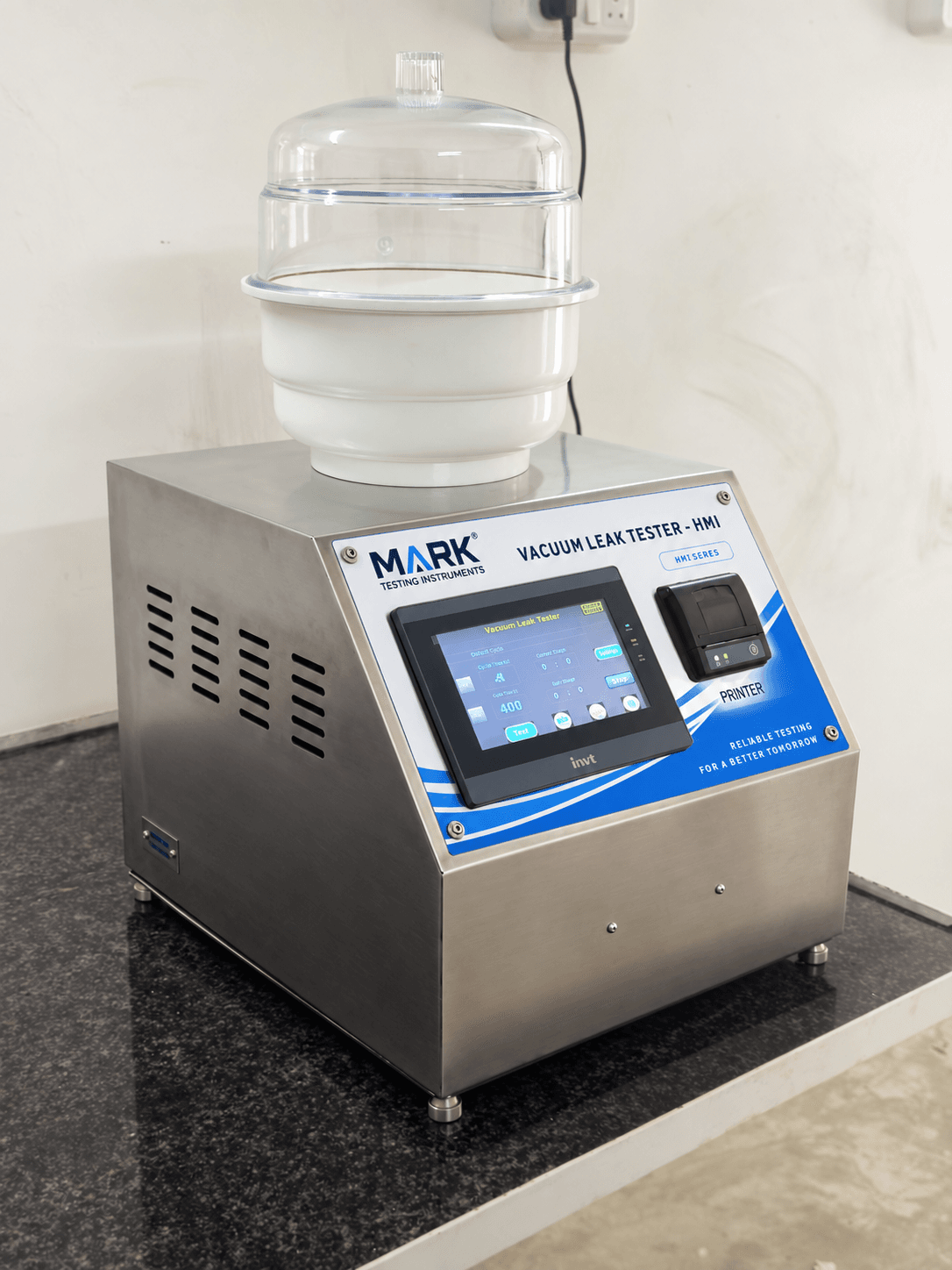
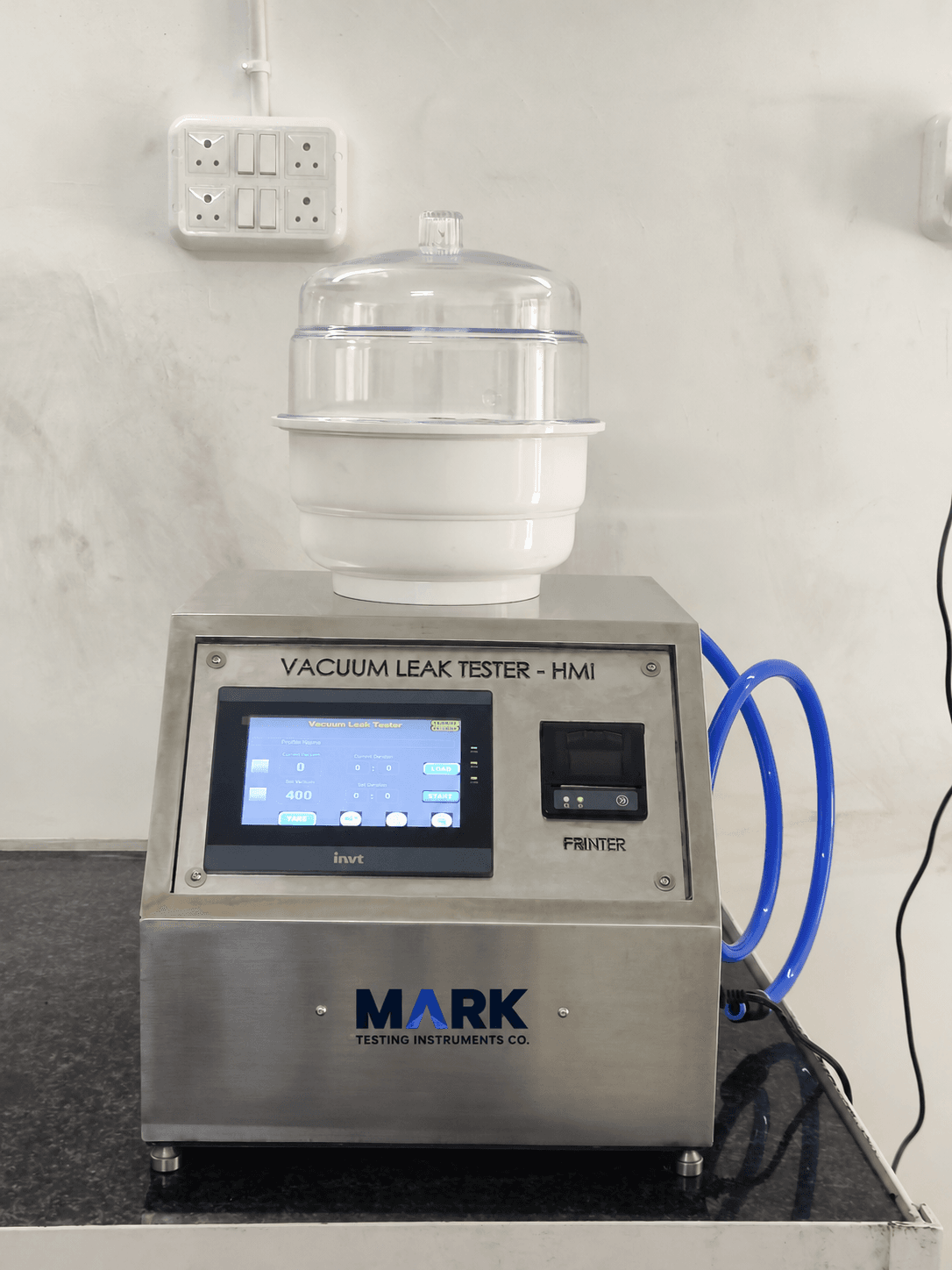
The MARK-VLT HMI 650 provides a 7-inch HMI touchscreen interface.
Key functions include:
- 7-inch color touchscreen
- Programmable test operation
- Vacuum stabilization
- Hold-time control
- Up to 10 pre-test profiles
- Internal result storage
- Date and time records
- Password-protected access
- USB data transfer on applicable configurations
- Storage for up to 1,000 test results
For laboratories repeatedly testing multiple products, stored profiles can simplify operation and reduce repeated parameter entry.
15. HMI Vacuum Leak Tester with Thermal Printer
The MARK-VLT HMI 650P combines:
7-Inch HMI Touchscreen + Automated Test Control + Data Storage + Thermal Printing
Depending on the configured report, test documentation can include:
- Company / Customer information
- Sample name
- Sample number
- Operator
- Set vacuum
- Date
- Time
- Pass / Fail result
- Remarks
This configuration can be suitable where both electronic test management and immediate physical records are required.
16. Define Data Requirements Before Buying
Modern QC laboratories generate increasing amounts of test data.
Before purchasing the instrument, ask:
What needs to happen to the test result after the test is completed?
Determine whether you need to retain:
- Test number
- Sample identification
- Product name
- Batch number
- Operator
- Set vacuum
- Actual vacuum
- Hold time
- Date
- Time
- Pass / Fail status
- Remarks
Selected MARK HMI systems can store up to 1,000 test results, depending on configuration.
Defining data requirements before purchase helps prevent future workflow limitations.
17. Consider Stored Test Profiles
If the laboratory tests multiple products, repeatedly entering parameters can be inefficient.
Stored test profiles can allow operators to save predefined test configurations.
Potential benefits include:
- Faster test setup
- Reduced repetitive parameter entry
- More consistent testing
- Easier operation across multiple products
Selected MARK HMI configurations support up to 10 pre-test profiles.
18. Evaluate User Access and Password Protection
A modern laboratory may require controlled instrument access.
Depending on the quality system, requirements can include:
- Password protection
- Individual users
- Different access levels
- Administrator control
- Restricted parameter modification
- Operator identification
These requirements should be defined before the machine is purchased.
19. Determine Whether You Need USB Data Transfer
USB functionality can be useful when test data needs to be transferred from a standalone instrument.
However, laboratories should consider more than simply whether a USB port is available.
Define:
- What data can be exported?
- Who is authorized to export it?
- What file format is used?
- How will records be retained?
- What is the backup procedure?
Selected MARK HMI configurations support USB data transfer.
20. Consider Real-Time Vacuum Graphs
Advanced systems can display vacuum behavior during the test.
Real-time graphical monitoring can help visualize:
- Vacuum generation
- Stabilization
- Hold period
- Test progression
- Vacuum release
Graphical data can also assist during method development and troubleshooting.
This functionality is particularly useful where laboratories want more information than a single displayed vacuum value.
21. Pharmaceutical Laboratories May Need Additional Controls
Pharmaceutical laboratories can have more demanding electronic-record requirements.
For these applications, MARK offers the:
MARK-VLT HMI 650P Pharma – 21 CFR Part 11 Ready Version
Depending on configuration, advanced functions can include:
- 7-inch HMI touchscreen
- Multi-level user access
- Password protection
- Audit-trail functionality
- Electronic record management
- Electronic signature support
- Internal real-time clock
- Test-data storage
- USB data handling
- Backup and restore
- Inbuilt thermal printer
- Real-time vacuum monitoring
- Vacuum curve display
- Automatic test countdown
- Automatic vacuum release
Important: Instrument functionality alone does not make an entire laboratory process compliant with 21 CFR Part 11.
Compliance can also depend on validation, procedures, training, access control, record retention, data review, backup, change control, and the user's overall quality system.
22. Evaluate Calibration Requirements
Calibration capability should be considered before purchasing laboratory equipment.
For a Vacuum Leak Tester, relevant parameters may include:
- Vacuum measurement
- Timer
- Associated sensors and controls
Before ordering, ask:
- What parameters can be calibrated?
- Is traceable calibration available?
- What documentation is supplied?
- Can recalibration be supported?
- Is service available in your region?
The calibration interval should be established according to the laboratory's quality system, instrument usage, and applicable requirements.
23. Consider Serviceability and Maintenance
A laboratory instrument is a long-term investment.
Before purchasing, consider:
- Preventive maintenance requirements
- Spare-part availability
- Remote technical support
- Troubleshooting support
- Calibration support
- Software support, where applicable
- Operator training
- Warranty
MARK Vacuum Leak Tester systems are supplied with a 12-month standard warranty, subject to applicable commercial and warranty terms.
24. Consider International Support Before Importing
For international buyers, machine specifications are only part of the purchasing decision.
Also evaluate:
- Export packaging
- Electrical requirements
- Documentation
- Installation requirements
- Remote technical support
- Calibration documentation
- Spare parts
- User manuals
- Training requirements
Before placing an international order, confirm the required electrical supply and any country-specific documentation.
Vacuum Leak Tester Selection Checklist
Use this checklist before requesting a quotation.
| Parameter | Requirement to Define |
|---|---|
| Package Type | What will be tested? |
| Test Method | Which standard or procedure applies? |
| Vacuum Range | What working vacuum is required? |
| Accuracy | What measurement accuracy is needed? |
| Sample Size | What is the largest package? |
| Chamber | What chamber size is required? |
| Hold Time | How long is the test? |
| Automation | Digital, HMI, or Computerized? |
| Profiles | Are stored recipes required? |
| Data Storage | How many results must be retained? |
| Printer | Is a physical report required? |
| Software | Is PC-based reporting required? |
| USB | Is data export required? |
| Users | Is controlled access required? |
| Audit Trail | Is it required by the quality system? |
| Calibration | What traceability is required? |
| Validation | Is additional documentation required? |
| Support | What after-sales support is required? |
Common Mistakes When Choosing a Vacuum Leak Tester
Selecting Only by Maximum Vacuum
A higher maximum vacuum does not automatically mean better testing.
Select the working range according to the actual procedure.
Ignoring Chamber Size
An advanced machine is of little use if the intended package cannot be accommodated correctly.
Choosing Only by Price
The lowest-priced instrument may not provide the automation, accuracy, reporting, or data management required by the laboratory.
Buying Every Available Feature
More features are not automatically better.
A routine QC laboratory may not require advanced pharmaceutical data controls.
Ignoring Future Data Requirements
A laboratory that currently records results manually may later require electronic reports, user management, or stored test histories.
Consider realistic future requirements when selecting the configuration.
Assuming Every Leak-Test Standard Is the Same
Different standards can use different test principles.
Always verify the applicable method before purchasing equipment.
Which MARK Vacuum Leak Tester Configuration Should You Choose?
| Laboratory Requirement | Suggested Configuration |
|---|---|
| Routine package testing | MARK-VLT 650 |
| Routine testing + printed report | MARK-VLT 650P |
| PC-based electronic reporting | MARK-CVLT 650 |
| Standalone touchscreen automation | MARK-VLT HMI 650 |
| HMI automation + printed reports | MARK-VLT HMI 650P |
| Advanced pharmaceutical data controls | MARK-VLT HMI 650P Pharma |
The final configuration should always be confirmed against the actual package, test procedure, and laboratory requirements.
Frequently Asked Questions
What should I look for when buying a Vacuum Leak Tester?
Start with the package and applicable test method. Then compare vacuum range, measurement accuracy, chamber size, vacuum control, hold-time functionality, automation, data storage, reporting, calibration, and service support.
Is an HMI Vacuum Leak Tester better than a Digital model?
Not necessarily.
An HMI model provides more automation, stored profiles, touchscreen control, and data-management functionality.
For straightforward routine testing, a Digital model may be sufficient.
Do I need a Computerized Vacuum Leak Tester?
A computerized model is useful where PC-based operation, electronic reports, automatic report storage, and historical data management are important.
Why is chamber size important?
The chamber must accommodate the largest intended package while allowing the applicable test procedure to be performed correctly.
Do I need an inbuilt thermal printer?
A thermal printer is useful when immediate physical test records are required. Laboratories using electronic reporting may prefer computerized data management instead.
How much test data can an HMI model store?
Selected MARK HMI Vacuum Leak Tester configurations can store up to 1,000 test results, depending on the model and configuration.
Is 21 CFR Part 11 functionality required for every laboratory?
No.
These features are relevant where the user's regulated workflow requires advanced electronic-record, access-control, audit-trail, or electronic-signature functionality.
Conclusion
Choosing a Vacuum Leak Tester for a modern quality control laboratory requires more than comparing vacuum capacity and price.
The selection should follow a structured process:
Package → Test Method → Vacuum Range → Accuracy → Chamber → Automation → Data → Reporting → Calibration → Support
A routine QC laboratory may require a straightforward Digital Vacuum Leak Tester.
A laboratory requiring physical reports may benefit from a printer-equipped model.
A data-oriented laboratory may prefer a Computerized system.
A high-volume laboratory may benefit from a 7-inch HMI Touchscreen Vacuum Leak Tester with stored profiles and test records.
Pharmaceutical laboratories may require additional controls for users, electronic records, audit trails, and electronic signatures.
The best instrument is therefore not necessarily the machine with the most features.
It is the machine that matches the laboratory's actual testing, documentation, and quality-control requirements.
MARK Vacuum Leak Testing Solutions
MARK Testing Instruments provides multiple Vacuum Leak Tester configurations for modern quality-control laboratories.
Available Models
- MARK-VLT 650 – Digital
- MARK-VLT 650P – Digital with Thermal Printer
- MARK-CVLT 650 – Computerized
- MARK-VLT HMI 650 – 7-Inch HMI Touchscreen
- MARK-VLT HMI 650P – HMI Touchscreen with Thermal Printer
- MARK-VLT HMI 650P Pharma – 21 CFR Part 11 Ready Version
Need Help Selecting a Vacuum Leak Tester?
For an appropriate equipment recommendation, send us:
Package Type + Maximum Sample Dimensions + Applicable Test Method + Required Vacuum + Reporting / Data Requirements
MARK Testing Instruments
Email: sales@marktestinginstruments.com
Website: www.marktestinginstruments.com
View Product Page https://www.marktestinginstruments.com/category/paper-and-packaging-testing/product/7-hmi-touchscreen-vacuum-leak-tester-with-thermal-printer