How to Choose a Bursting Strength Tester for Indian Quality Control Laboratories
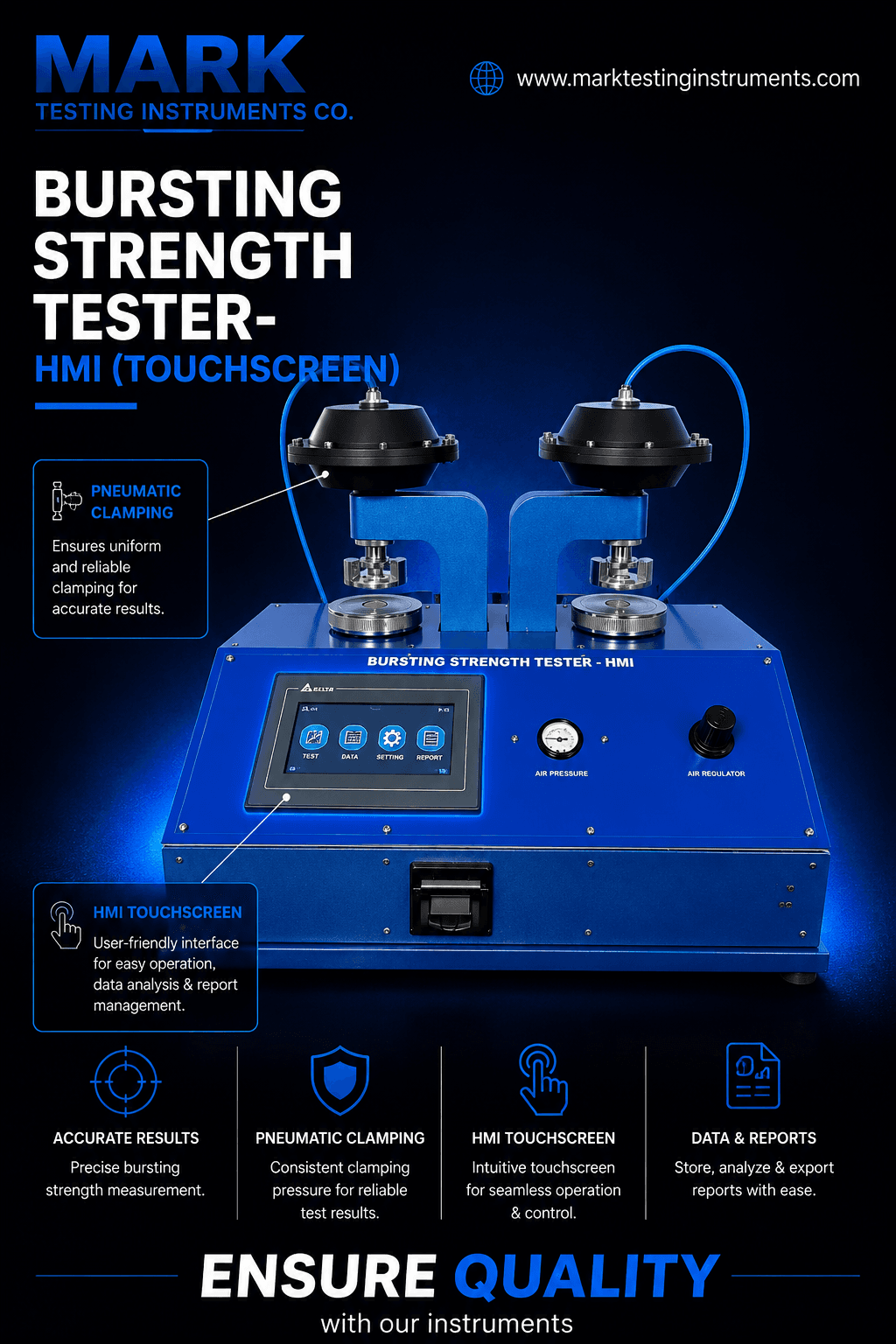
Learn how to choose a Bursting Strength Tester in India for paper, corrugated board and packaging quality control. Compare Digital, Pneumatic, Computerized and HMI models, technical specifications, standards, reporting features and price factors.
How to Choose a Bursting Strength Tester for Indian Quality Control Laboratories
Selecting the right Bursting Strength Tester in India is an important decision for paper manufacturers, corrugated box manufacturers, packaging suppliers and quality-control laboratories.
A Bursting Strength Tester measures the pressure required to rupture a suitable paper or paperboard specimen under controlled hydraulic loading.
Bursting strength is an important quality-control parameter for evaluating material performance, comparing production batches and verifying packaging material specifications.
However, laboratories have different requirements for automation, clamping, measurement range, test documentation and reporting.
MARK Testing Instruments offers Digital, Pneumatic Digital with Printer, Pneumatic Computerized and Pneumatic HMI Touchscreen Bursting Strength Tester configurations.
This buying guide explains how to select the appropriate model for your laboratory.
What Is a Bursting Strength Tester?
A Bursting Strength Tester is a laboratory instrument used to determine the bursting resistance of paper, paperboard and suitable corrugated packaging materials.
During testing, a specimen is securely clamped over a flexible diaphragm.
Hydraulic pressure causes the diaphragm to expand against the specimen until rupture occurs.
The instrument measures the pressure at the point of bursting.
Bursting strength results help manufacturers evaluate material consistency and compliance with relevant product specifications.
Why Is Bursting Strength Testing Important?
Paper and corrugated packaging materials must provide adequate strength during handling, conversion, storage and distribution.
Bursting strength testing helps manufacturers:
- Evaluate paper and paperboard quality
- Compare material grades
- Monitor production consistency
- Verify supplier specifications
- Evaluate corrugated board performance
- Investigate material-related failures
- Support incoming-material inspection
- Maintain quality-control records
Bursting strength is one material property and should not be treated as a substitute for box compression, edge crush or other packaging performance tests.
Applications of Bursting Strength Testing
Bursting Strength Testers are commonly used in:
Paper Manufacturing
To evaluate bursting resistance and production consistency across suitable paper grades.
Corrugated Box Manufacturing
To measure bursting strength of suitable corrugated board materials used in packaging.
Paperboard Manufacturing
To assess material strength and compare board specifications.
Packaging Quality Control
To verify raw-material and finished-board specifications where bursting strength is required.
Research and Development
To compare material formulations, construction and manufacturing changes.
Types of Bursting Strength Testers Available in India
MARK Testing Instruments offers multiple configurations to meet different quality-control requirements.
1. Digital Bursting Strength Tester — Manual Clamp
The Digital Bursting Strength Tester with Manual Clamp is suitable for routine quality-control testing.
Key features
- Digital bursting pressure indication
- Manual specimen clamping
- Hydraulic pressure generation
- Peak bursting pressure measurement
- User-friendly controls
- Robust machine construction
- Suitable for routine paper and packaging QC
This configuration is appropriate where straightforward testing is required without advanced software or automated clamping.
2. Pneumatic Digital Bursting Strength Tester with Printer
This model uses pneumatic specimen clamping and includes a digital measuring system with thermal printing.
Key features
- Pneumatic specimen clamping
- Digital bursting pressure measurement
- Inbuilt thermal printer
- Peak pressure display
- Improved clamping consistency
- Immediate test documentation
Depending on configuration, printed reports can include:
- Test number
- Date and time
- Bursting pressure
- Sample identification
- Remarks
3. Pneumatic Computerized Bursting Strength Tester
The Computerized configuration is designed for laboratories requiring software-based test documentation.
Key features
- Pneumatic specimen clamping
- Computer interface
- Software-based testing and reporting
- Electronic result storage
- Test-data review
- Report generation
- Graphical display where configured
This configuration is useful for laboratories requiring electronic records and advanced reporting.
4. Pneumatic HMI Touchscreen Bursting Strength Tester
The HMI configuration provides standalone touchscreen operation.
Key features
- HMI touchscreen interface
- Pneumatic clamping
- Digital bursting pressure measurement
- Programmable test parameters
- User-friendly operation
- Stored test information, depending on configuration
- Inbuilt thermal printer on printer-equipped models
The HMI version is suitable for laboratories requiring advanced operation without relying on a separate computer for routine tests.
MARK Bursting Strength Tester Technical Specifications
The following specifications describe MARK's standard Digital manual-clamp configuration. Other configurations should be confirmed separately.
| Parameter | Specification |
|---|---|
| Instrument | Bursting Strength Tester |
| Brand | MARK Testing Instruments |
| Standard Measurement Range | 0–40 kg/cm² |
| Display | Digital |
| Least Count | 0.01 kg/cm² |
| Accuracy | ±1% |
| Pressure Medium | Glycerine |
| Hydraulic Flow Rate | 95 cc/min |
| Specimen Clamping | Manual |
| Pneumatic Clamping | Available on selected variants |
| Thermal Printer | Available on selected variants |
| Computer Software | Available on Computerized variants |
| HMI Touchscreen | Available on HMI variants |
| Warranty | 12 Months |
Important: The suitable measurement range, diaphragm, clamping arrangement and hydraulic flow rate must be checked against the selected test method and material grade.
Bursting Strength Testing Standards
Different standards apply to different paper and paperboard materials.
ASTM D774/D774M
ASTM D774/D774M covers bursting strength testing of paper.
ISO 2758
ISO 2758 specifies a method for determining the bursting strength of paper.
ISO 2759
ISO 2759 specifies a method for determining the bursting strength of board.
The correct method should be selected according to the material and required test conditions.
A machine should not be assumed to conform to every standard solely because it measures bursting pressure.
How to Choose the Right Bursting Strength Tester
1. Identify the Material
Determine whether you need to test:
- Paper
- Paperboard
- Corrugated board
- Packaging paper
- Other suitable sheet materials
Material type influences the required test method and machine configuration.
2. Select the Applicable Standard
Confirm whether the testing requirement follows ASTM D774/D774M, ISO 2758, ISO 2759 or another customer-specified method.
3. Check the Measurement Range
The tester must provide a suitable pressure range for the expected bursting strength.
4. Compare Clamping Systems
Manual clamping is suitable for many routine testing applications.
Pneumatic clamping can help provide more consistent specimen holding when correctly configured.
5. Evaluate Measurement Accuracy
Check the specified measurement accuracy and calibration requirements.
Display resolution should not be confused with measurement accuracy.
6. Consider Test Documentation
Select the reporting system according to your laboratory workflow:
- Digital display
- Printed report
- Computerized report
- HMI result storage
- Electronic data export
7. Confirm Calibration Requirements
Discuss calibration scope, traceability and documentation before ordering.
Bursting Strength Tester Price in India
The price of a Bursting Strength Tester depends on its technical configuration.
Important price factors include:
- Measurement range
- Manual or pneumatic clamping
- Digital controller
- HMI touchscreen
- Computer software
- Thermal printer
- Data storage
- Report generation
- Calibration documentation
- Installation requirements
A standard Digital manual-clamp model and an advanced HMI model may have different prices because of their control, clamping and reporting systems.
For an accurate quotation, buyers should provide the material, applicable standard and required configuration.
Bursting Strength Tester for Noida and Delhi NCR
Paper, corrugated packaging and industrial quality-control laboratories in Noida and Delhi NCR can evaluate MARK Bursting Strength Tester configurations according to their testing requirements.
A routine production laboratory may prefer a Digital system, while a laboratory requiring electronic reports may benefit from Computerized or HMI configurations.
Common Mistakes When Buying a Bursting Strength Tester
- Selecting a tester without identifying the material
- Ignoring the applicable test standard
- Choosing an unsuitable pressure range
- Assuming all clamping systems are equivalent
- Comparing equipment only by price
- Overlooking calibration requirements
- Failing to confirm printer and software features
- Assuming bursting strength alone predicts finished-box stacking performance
Frequently Asked Questions
What is a Bursting Strength Tester?
A Bursting Strength Tester measures the pressure required to rupture a suitable paper or paperboard specimen under controlled hydraulic loading.
What is the difference between manual and pneumatic clamping?
Manual clamping requires operator adjustment, while pneumatic clamping uses controlled air pressure to hold the specimen.
Which standards are applicable?
ASTM D774/D774M, ISO 2758 and ISO 2759 are relevant depending on the material and test objective.
Is an HMI Bursting Strength Tester available?
Yes. MARK offers HMI touchscreen configurations with pneumatic clamping and reporting features depending on the model.
Is a Computerized Bursting Strength Tester available?
Yes. Computerized configurations are available for software-based testing and reporting.
What is the price of a Bursting Strength Tester in India?
Pricing depends on the measurement range, clamping system, controller, printer, software and calibration requirements.
Request a Bursting Strength Tester Quotation
MARK Testing Instruments offers Digital, Pneumatic, Computerized and HMI Bursting Strength Tester configurations.
For model selection, provide:
Material Type + Expected Bursting Pressure + Applicable Standard + Clamping Preference + Reporting Requirements
MARK Testing Instruments
Email: sales@marktestinginstruments.com
Website: www.marktestinginstruments.com
