How Bursting Strength Tester Improves Quality Control in Corrugated Packaging

Understand how Bursting Strength Testing supports corrugated packaging quality control. Learn the working principle, testing procedure, relevant standards, result interpretation and laboratory best practices.
How Bursting Strength Tester Improves Quality Control in Corrugated Packaging
Corrugated packaging is widely used to protect products during handling, storage and transportation.
Maintaining consistent material strength is an important requirement for corrugated packaging manufacturers and quality-control laboratories.
A Bursting Strength Tester provides a controlled method for measuring the resistance of suitable paper and paperboard materials to rupture under hydraulic pressure.
Bursting strength testing helps manufacturers monitor material consistency, evaluate incoming materials and verify product specifications.
This article explains the working principle, testing procedure, applicable standards and role of bursting strength measurement in corrugated packaging quality control.
What Is Bursting Strength?
Bursting strength is the maximum pressure a suitable specimen withstands under a specified bursting test before rupture.
It is measured using a testing system in which hydraulic pressure expands a flexible diaphragm against the specimen.
The measured value provides information about the material's resistance to rupture under the test conditions.
Bursting strength is influenced by material properties, specimen condition and test method.
Why Bursting Strength Matters in Corrugated Packaging
Corrugated packaging is manufactured from linerboard and fluting materials.
Material quality influences the performance and consistency of the finished board.
Bursting strength testing helps laboratories:
- Evaluate material consistency
- Compare board grades
- Verify incoming-material specifications
- Monitor manufacturing changes
- Identify unexpected material variations
- Maintain documented QC records
- Support product development
- Investigate quality deviations
However, bursting strength should be evaluated alongside other relevant properties.
For example, Box Compression Testing evaluates compressive resistance of a package, while Edge Crush Testing measures edgewise compression resistance of corrugated board.
These tests provide different information and should not be treated as interchangeable.
Working Principle of a Bursting Strength Tester
A Bursting Strength Tester uses hydraulic pressure to expand a flexible diaphragm against a clamped specimen.
Main Components
A typical system includes:
- Specimen clamping assembly
- Flexible diaphragm
- Hydraulic pressure generation system
- Pressure measurement system
- Digital display or controller
- Safety and operating controls
- Reporting system, depending on configuration
Working Sequence
- The specimen is prepared according to the selected standard.
- The specimen is positioned over the diaphragm.
- The specimen is securely clamped.
- Hydraulic pressure is applied.
- The diaphragm expands against the specimen.
- The specimen ruptures.
- The maximum bursting pressure is recorded.
The required clamping conditions, pressure application rate and diaphragm characteristics depend on the applicable test method.
Step-by-Step Bursting Strength Testing Procedure
Step 1: Identify the Applicable Standard
Select the test method appropriate to the material.
Commonly referenced methods include ASTM D774/D774M, ISO 2758 and ISO 2759.
Step 2: Prepare the Specimen
Prepare suitable test specimens according to the selected standard.
Avoid damaged, creased or contaminated specimens unless the testing objective specifically requires them.
Step 3: Condition the Material
Condition specimens according to the relevant testing requirements.
Paper and paperboard properties can be affected by temperature and humidity.
Step 4: Inspect the Instrument
Before testing, check:
- Diaphragm condition
- Clamping surfaces
- Hydraulic system
- Pressure indication
- Calibration status
- Safety functions
Step 5: Position the Specimen
Place the specimen correctly over the diaphragm.
Ensure the specimen is aligned and adequately supported by the clamping assembly.
Step 6: Apply the Required Clamping Force
Clamp the specimen according to the selected test method.
Insufficient clamping can cause specimen slippage.
Excessive or unsuitable clamping may influence the result.
Step 7: Start the Test
Apply hydraulic pressure using the required test conditions.
The diaphragm expands and applies pressure to the specimen.
Step 8: Record the Bursting Pressure
Record the maximum pressure at rupture.
Step 9: Repeat the Test
Perform the required number of measurements according to the selected standard and laboratory procedure.
Step 10: Evaluate the Results
Compare the results with the applicable material specification and acceptance criteria.
Relevant Bursting Strength Testing Standards
ASTM D774/D774M
ASTM D774/D774M addresses bursting strength testing of paper.
ISO 2758
ISO 2758 specifies a method for determining the bursting strength of paper.
ISO 2759
ISO 2759 specifies a method for determining the bursting strength of board.
The correct method must be selected according to the material and the standard's scope.
For corrugated packaging, the applicable procedure should be confirmed before testing.
Bursting Strength Tester Technical Specifications
MARK's standard Digital manual-clamp configuration includes:
| Parameter | Specification |
|---|---|
| Measurement Range | 0–40 kg/cm² |
| Resolution | 0.01 kg/cm² |
| Accuracy | ±1% |
| Pressure Medium | Glycerine |
| Hydraulic Flow Rate | 95 cc/min |
| Display | Digital |
| Clamping | Manual |
| Pneumatic Clamping | Optional variants |
| Computer Software | Available on selected variants |
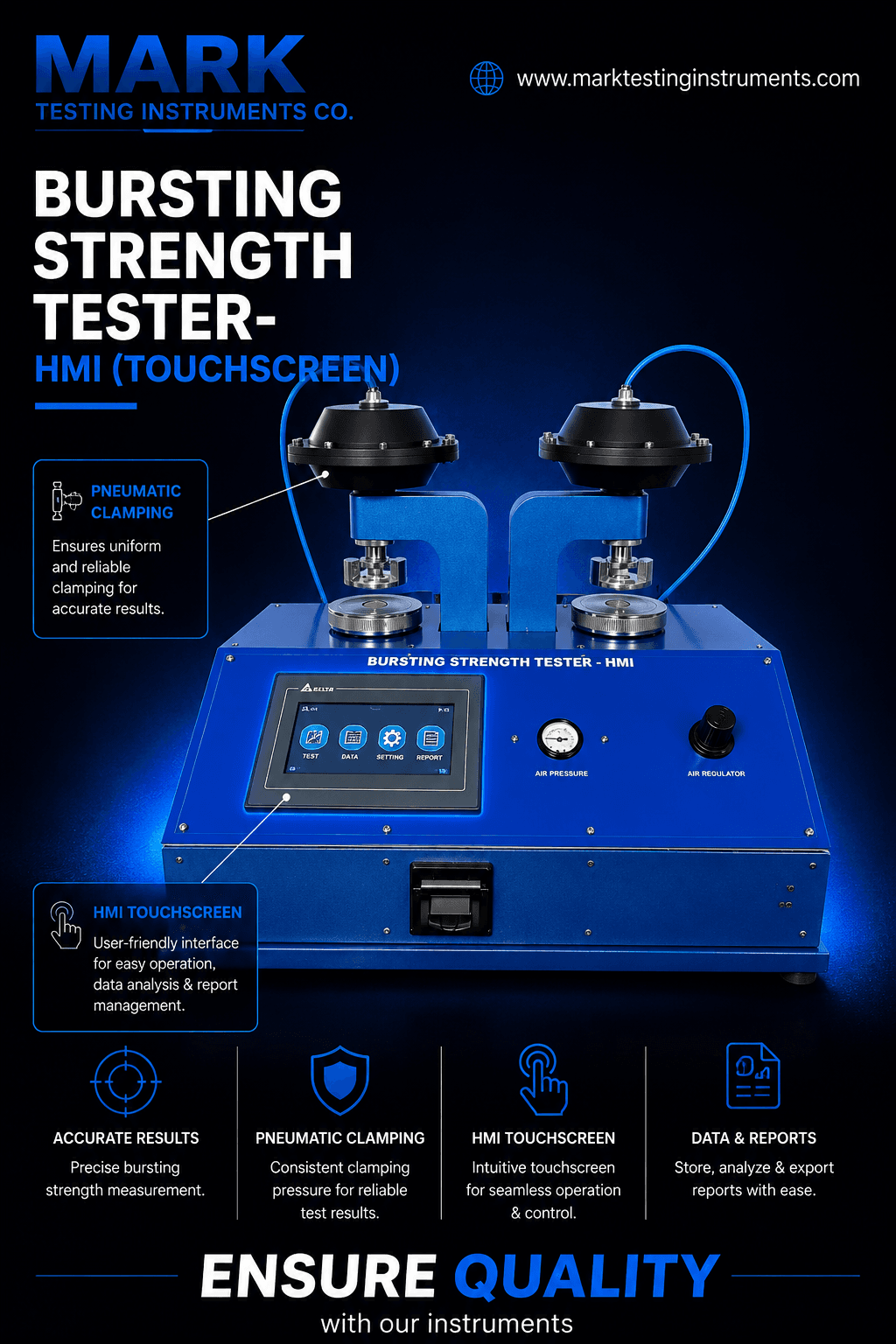
| HMI Touchscreen | Available on selected variants |
| Thermal Printer | Available on selected variants |
These specifications describe selected MARK configurations. Suitability for a particular test method must be verified separately.
Digital, Pneumatic, Computerized and HMI Systems
Digital Manual-Clamp System
Suitable for straightforward routine bursting strength measurement.
Pneumatic Digital System
Uses pneumatic clamping and digital pressure measurement.
Printer-equipped configurations can generate immediate test records.
Computerized System
Suitable for laboratories requiring electronic reports, stored results and software-based operation.
HMI Touchscreen System
Provides touchscreen-based standalone operation and advanced reporting functions depending on configuration.
How Bursting Strength Testing Improves Quality Control
1. Incoming-Material Verification
Bursting strength results can help confirm whether incoming paper or board meets the specified requirements.
2. Production Consistency
Routine testing helps detect unexpected variations between production batches.
3. Material Grade Comparison
Laboratories can compare different paperboard grades using consistent test methods.
4. Process Improvement
Testing can help assess the effect of changes in raw materials or manufacturing conditions.
5. Quality Documentation
Recorded results provide evidence for internal QC review and customer specifications.
6. Failure Investigation
Bursting strength data can contribute to investigating material-related packaging failures.
Factors Affecting Bursting Strength Results
Several factors can influence the measured value.
Material Composition
Fibre characteristics, material construction and manufacturing conditions influence material strength.
Moisture and Conditioning
Paper and paperboard are sensitive to environmental conditions.
Diaphragm Condition
A damaged or unsuitable diaphragm can affect the testing process.
Clamping
Incorrect clamping may cause slippage or inconsistent loading.
Hydraulic Pressure Application
Pressure application conditions must follow the selected test method.
Calibration
Measurement accuracy and calibration status influence result reliability.
Common Testing Errors
- Using the wrong standard
- Testing unsuitable materials
- Incorrect specimen conditioning
- Damaged diaphragm
- Incorrect clamping
- Specimen slippage
- Unverified pressure measurement
- Incorrect hydraulic flow conditions
- Insufficient number of specimens
- Incomplete test documentation
A documented testing procedure helps reduce these risks.
Bursting Strength vs Box Compression Strength
These tests measure different properties.
| Parameter | Bursting Strength Test | Box Compression Test |
|---|---|---|
| Main Property | Resistance to rupture under hydraulic pressure | Resistance to compressive loading |
| Typical Specimen | Paper / Paperboard / Suitable Board | Corrugated Box / Shipping Container |
| Main Result | Bursting Pressure | Compression Load |
| Typical Purpose | Material Quality Evaluation | Package Compression Evaluation |
Both methods may be useful in a comprehensive corrugated packaging quality-control programme.
Importance of Calibration and Maintenance
Regular inspection and appropriate calibration help maintain reliable testing performance.
Laboratories should consider:
- Pressure measurement verification
- Diaphragm inspection
- Hydraulic system condition
- Clamping assembly condition
- Mechanical maintenance
- Test-record documentation
Calibration and maintenance should follow the instrument manufacturer's instructions and laboratory quality requirements.
Bursting Strength Testing for International Packaging Laboratories
Laboratories in international markets, including the United Arab Emirates, may require bursting strength testing for paperboard and corrugated packaging quality control.
Before selecting equipment, confirm:
- Material type
- Applicable standard
- Required pressure range
- Clamping system
- Accuracy
- Calibration requirements
- Data reporting
- Electrical requirements
- Technical documentation
Frequently Asked Questions
What does a Bursting Strength Tester measure?
It measures the pressure required to rupture a suitable specimen under specified hydraulic bursting test conditions.
Why is bursting strength important in corrugated packaging?
It helps evaluate material quality and consistency, supporting manufacturing quality control and specification verification.
Which standard applies to board?
ISO 2759 is a relevant board bursting strength method. The material and standard scope must be checked before testing.
Can bursting strength predict box stacking strength?
Not by itself. Box stacking performance depends on several factors and may require compression and other testing methods.
What is the benefit of pneumatic clamping?
Pneumatic clamping can provide controlled specimen holding when correctly configured and maintained.
Conclusion
Bursting strength testing is an important part of paper and corrugated packaging quality control.
It helps manufacturers evaluate material consistency, verify specifications and maintain documented testing results.
Reliable testing depends on the correct standard, specimen preparation, instrument configuration, calibration and operating procedure.
MARK Bursting Strength Testing Solutions
MARK Testing Instruments offers Digital, Pneumatic Digital with Printer, Computerized and HMI Touchscreen Bursting Strength Tester configurations.
Email: sales@marktestinginstruments.com
Website: www.marktestinginstruments.com