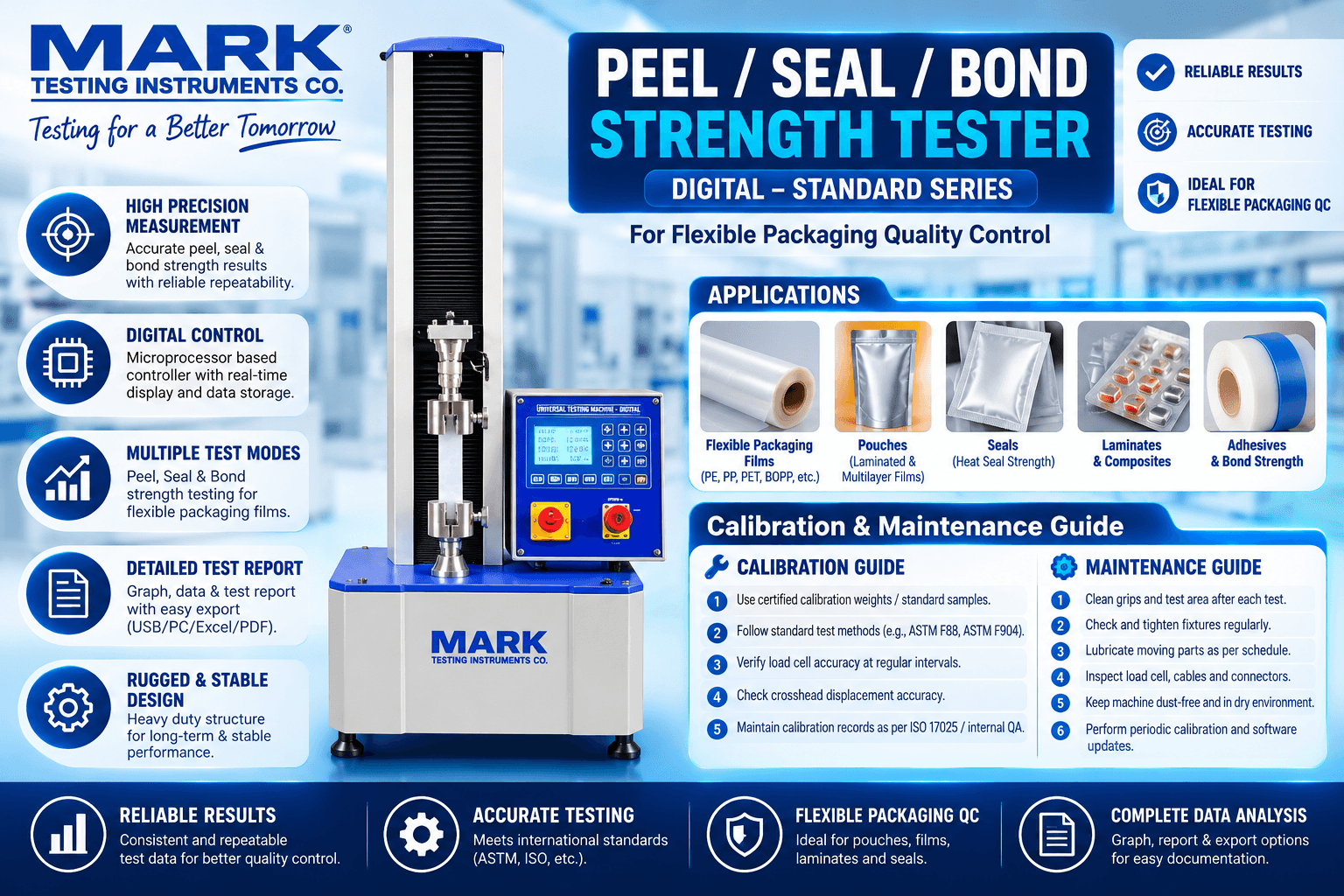
Digital vs HMI vs Computerized Peel/Seal/Bond Strength Tester: A Technical Comparison
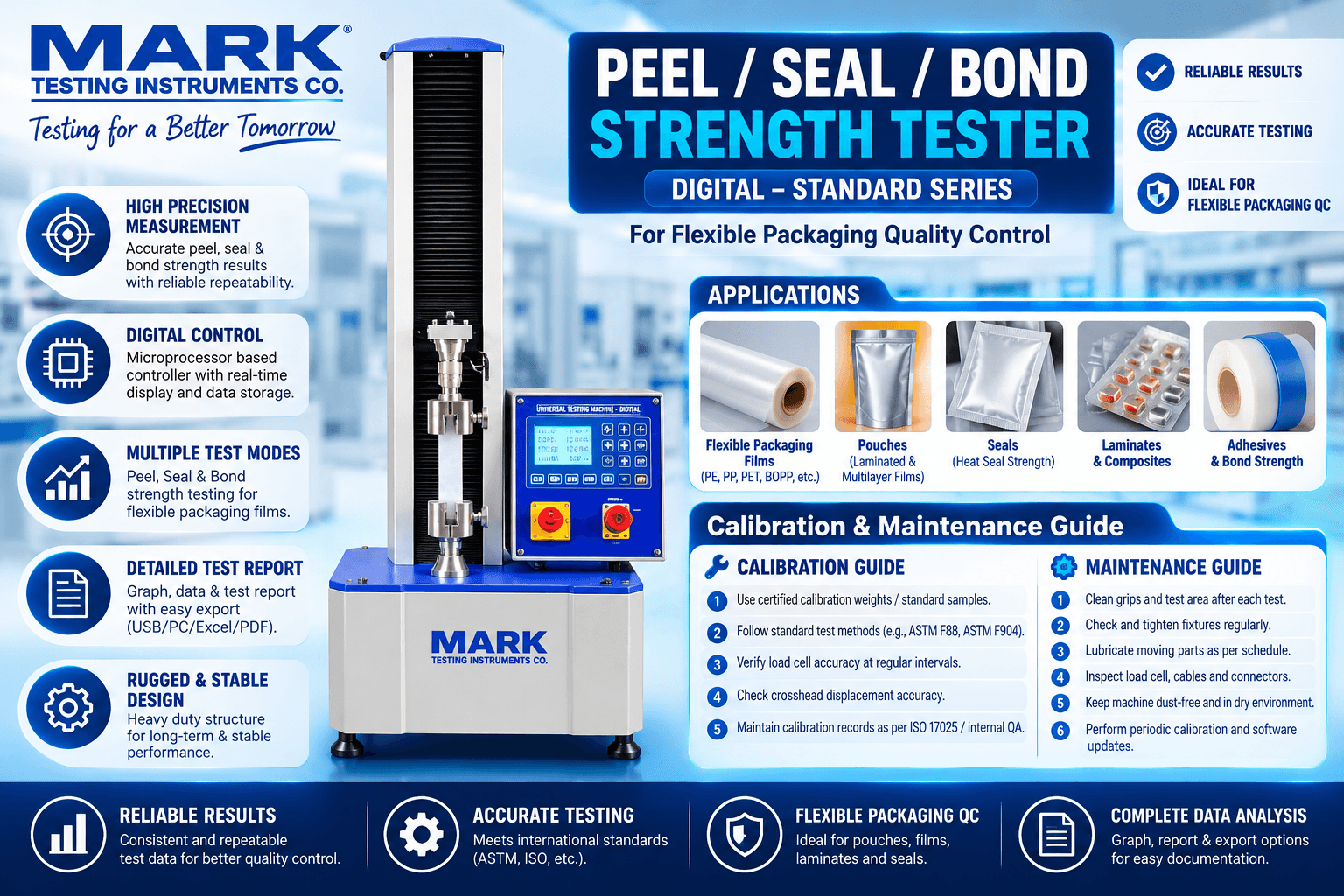
Compare Digital, HMI and Computerized Peel/Seal/Bond Strength Testers by force measurement, test control, peel geometry, graphs, data storage, reporting, calibration and suitability for ASTM F88 and ASTM D3330 testing.
Digital vs HMI vs Computerized Peel/Seal/Bond Strength Tester: A Technical Comparison
Selecting the correct Peel/Seal/Bond Strength Tester is an important decision for flexible packaging manufacturers, adhesive manufacturers and modern quality-control laboratories.
Different testing applications require different force ranges, gripping arrangements, test speeds, reporting capabilities and levels of automation.
Digital, HMI and Computerized testing systems can perform similar mechanical testing functions when properly configured, but their control and data-management capabilities differ.
This guide compares the main technical considerations for selecting the appropriate equipment.
What Does a Peel/Seal/Bond Strength Tester Measure?
A Peel/Seal/Bond Strength Tester measures the force required to separate suitable bonded or sealed materials under controlled conditions.
Applications include:
- Heat-seal strength testing
- Flexible packaging seal testing
- Pressure-sensitive tape peel testing
- Adhesive bond testing
- Laminate peel testing
- Label adhesion testing
- Suitable 90-degree peel testing
- Suitable 180-degree peel testing
The required force measurement, specimen geometry and reporting method depend on the selected standard.
1. Digital Peel/Seal/Bond Strength Tester
A Digital testing machine provides direct force measurement and basic test operation.
Main Features
- Digital load display
- Load-cell measurement
- Peak force indication
- Variable-speed testing
- Suitable specimen grips
- Straightforward operator controls
Advantages
- Simple operation
- Suitable for routine testing
- Lower reporting complexity
- Appropriate for laboratories needing direct force results
Considerations
Basic Digital configurations may not provide advanced force-curve analysis or extensive electronic result storage.
Best Suited For
- Routine production quality control
- Basic adhesive peel testing
- Basic seal strength evaluation
- Laboratories requiring straightforward operation
2. HMI Touchscreen Peel/Seal/Bond Strength Tester
An HMI system uses a touchscreen interface for test setup, operation and result review.
Potential Features
Depending on the selected MARK configuration:
- Touchscreen operation
- Test parameter entry
- Test profiles
- Peak force measurement
- Stored results
- Graphical display
- Password-controlled functions
- Thermal printing on printer-equipped versions
Advantages
- Standalone operation
- Convenient parameter entry
- Reduced dependence on a separate computer
- Suitable for structured production QC workflows
Considerations
Data storage, graphing, printer and export functions must be verified for the selected model.
Best Suited For
- Production quality-control laboratories
- Laboratories needing touchscreen operation
- Facilities requiring convenient test documentation
3. Computerized Peel/Seal/Bond Strength Tester
A Computerized system uses dedicated software for test control, result analysis and reporting.
Potential Features
- Software-based test setup
- Real-time force-versus-displacement graph
- Peak force measurement
- Average force calculation
- Test history
- Electronic reporting
- Data export
- Specimen identification
- Operator and batch information
Advantages
- Detailed result analysis
- Electronic documentation
- Flexible report generation
- Convenient comparison of test records
Considerations
Software compatibility, computer requirements, data storage and interface reliability should be confirmed before purchase.
Best Suited For
- Research and development
- Advanced flexible packaging laboratories
- Adhesive testing laboratories
- Facilities requiring electronic test documentation
4. Digital vs HMI vs Computerized — Comparison
| Feature | Digital | HMI | Computerized |
|---|---|---|---|
| Force Measurement | Yes | Yes | Yes |
| Peak Force | Yes | Configured | Configured |
| Test Speed Control | Model Dependent | Model Dependent | Model Dependent |
| Touchscreen | No | Yes | Not Required |
| Real-Time Graph | Not Standard | Selected Models | Selected Models |
| Electronic Storage | Limited / Optional | Selected Models | Selected Models |
| Thermal Printer | Printer Variant | Selected Models | Optional |
| Computer Software | No | HMI-cum-PC Variant | Yes |
| Electronic Reports | Limited | Model Dependent | Yes |
| Suitable for Routine QC | Yes | Yes | Yes |
| Advanced Data Analysis | Limited | Model Dependent | Yes |
These are configuration comparisons, not a claim that every model includes every listed function.
5. Important Technical Specifications
When comparing testing machines, check:
- Load-cell capacity
- Force accuracy
- Force resolution
- Test speed range
- Available travel
- Specimen grip type
- Peel geometry
- Fixture alignment
- Force graph capability
- Report calculations
- Calibration scope
MARK Digital Configuration
Selected MARK Digital Peel/Seal/Bond Strength Tester specifications include:
- Load-cell options: 3 kgf and 10 kgf
- Readability: 0.001 kg
- Stated accuracy: ±0.05%
- Variable-speed drive
- Digital load indication
- Peak-hold function
Computerized and HMI specifications should be confirmed separately.
6. ASTM F88/F88M — Seal Strength Testing
ASTM F88/F88M is relevant to measuring seal strength of flexible barrier materials.
Important considerations include:
- Specimen preparation
- Seal geometry
- Test configuration
- Testing speed
- Force measurement
- Result reporting
The selected machine must be equipped with suitable grips and configured for the method.
7. ASTM D3330/D3330M — Peel Adhesion Testing
ASTM D3330/D3330M addresses peel adhesion of pressure-sensitive tape.
Important considerations include:
- Tape specimen preparation
- Substrate
- Peel angle
- Testing speed
- Specimen conditioning
- Force reporting
Not every adhesive bond test falls under ASTM D3330.
8. Importance of Test Geometry
Peel and seal testing results can be influenced by the direction of applied force.
Common configurations include:
90-Degree Peel
The specimen is separated at a controlled 90-degree geometry using a suitable fixture.
180-Degree Peel
The specimen is folded back and separated at approximately 180 degrees under the specified method.
Seal Strength Testing
The specimen is separated using the geometry specified by the applicable seal strength procedure.
The machine and fixtures must maintain the required geometry throughout the test.
9. Force Measurement Accuracy
Force accuracy is important because many peel and seal tests involve relatively low forces.
When selecting a tester, verify:
- Appropriate load-cell range
- Force accuracy
- Resolution
- Repeatability
- Calibration range
- Measurement uncertainty where required
A very high-capacity load cell may not provide suitable measurement performance for low-force specimens.
10. Testing Speed
Testing speed can influence peel and seal strength results.
Before purchasing, verify:
- Minimum speed
- Maximum speed
- Speed control
- Speed verification
- Standard-specific speed requirements
Do not assume the same speed is appropriate for every adhesive or seal test.
11. Force-versus-Displacement Graph
A Computerized system may display the force response throughout the test.
Graphical data can help identify:
- Peak force
- Force variation
- Irregular separation
- Sudden force changes
- Potential grip slippage
- Changes in peel behaviour
Graph interpretation must follow the applicable testing method.
12. Average Peel Force Calculation
Some testing methods require reporting average force over a specified region.
The calculation may depend on:
- Selected evaluation interval
- Specimen width
- Force units
- Excluded initial region
- Selected test method
The software should support the correct calculation procedure.
13. Reporting and Data Management
Modern laboratories may require:
- Test number
- Date and time
- Operator
- Batch identification
- Material identification
- Test standard
- Specimen width
- Test speed
- Peak force
- Average force
- Graph
- Remarks
- Result units
The selected system should match the laboratory's documentation requirements.
14. Calibration and Maintenance
All configurations require appropriate inspection and measurement verification.
Important checks include:
- Force measurement
- Test speed
- Grip condition
- Fixture alignment
- Crosshead movement
- Calibration status
- Software calculations where applicable
A more advanced controller does not eliminate the need for calibration.
15. Choosing the Right Model
Choose Digital When:
- Routine testing is the main requirement
- Direct force results are sufficient
- Electronic reporting is not essential
Choose HMI When:
- Standalone touchscreen operation is preferred
- Operators need convenient test setup
- Stored results or printed records are required on the configured model
Choose Computerized When:
- Detailed force curves are required
- Electronic test reports are important
- Data analysis is a priority
- The laboratory needs software-based result management
16. Common Buying Mistakes
- Selecting a machine without confirming the test standard
- Using an unsuitable load-cell capacity
- Ignoring specimen width
- Choosing the wrong peel fixture
- Overlooking testing speed
- Assuming every HMI includes a printer
- Assuming all software calculates average peel force identically
- Confusing display resolution with accuracy
- Failing to confirm calibration scope
- Comparing models only by price
Frequently Asked Questions
Which model is best for routine seal testing?
A Digital model may be suitable where direct force measurement and basic reporting meet the laboratory's requirements.
Which model is best for detailed data analysis?
A Computerized model is generally more suitable when electronic graphs, result analysis and reporting are required.
Can an HMI tester work without a computer?
Standalone HMI configurations are designed for operation without a separate computer for their supported functions.
Can one machine perform ASTM F88 and ASTM D3330?
A suitably configured machine may support both methods using the required fixtures, grips and test settings.
Is calibration required for Computerized models?
Yes. Computerized systems require appropriate measurement verification and calibration.
Conclusion
Digital, HMI and Computerized Peel/Seal/Bond Strength Testers can support different levels of laboratory automation.
The correct selection depends on:
Material → Test Standard → Force Range → Test Geometry → Accuracy → Speed → Reporting → Calibration
A properly configured machine helps laboratories obtain reliable results and maintain consistent quality-control documentation.
MARK Peel/Seal/Bond Strength Testing Solutions
MARK Testing Instruments offers Digital, Printer, Computerized, HMI and HMI-cum-Computerized configurations.
For technical selection and quotation:
Email: sales@marktestinginstruments.com
Website: www.marktestinginstruments.com