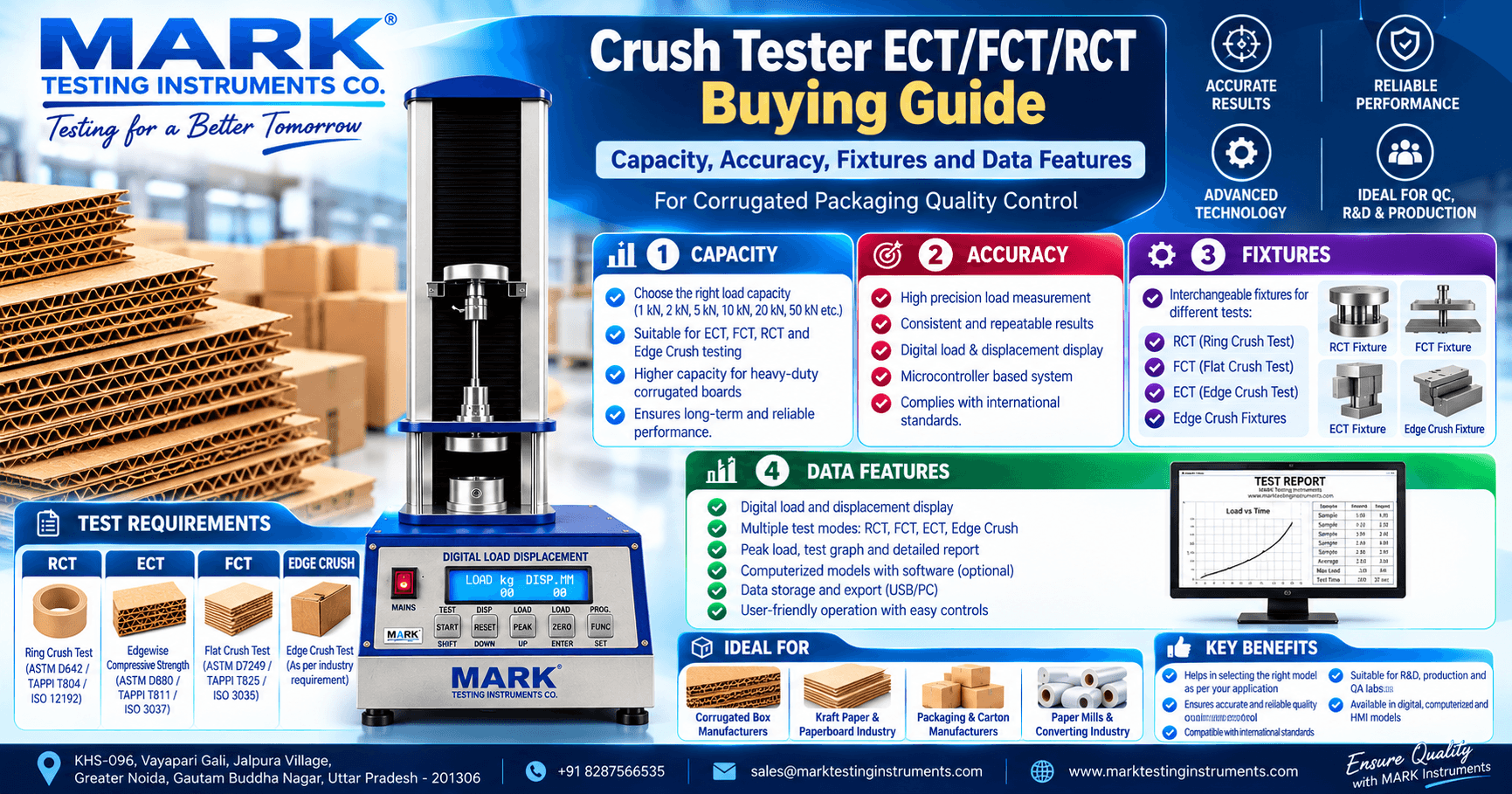
Crush Tester ECT/FCT/RCT for Corrugated Packaging: Test Requirements, Features & Buying Guide
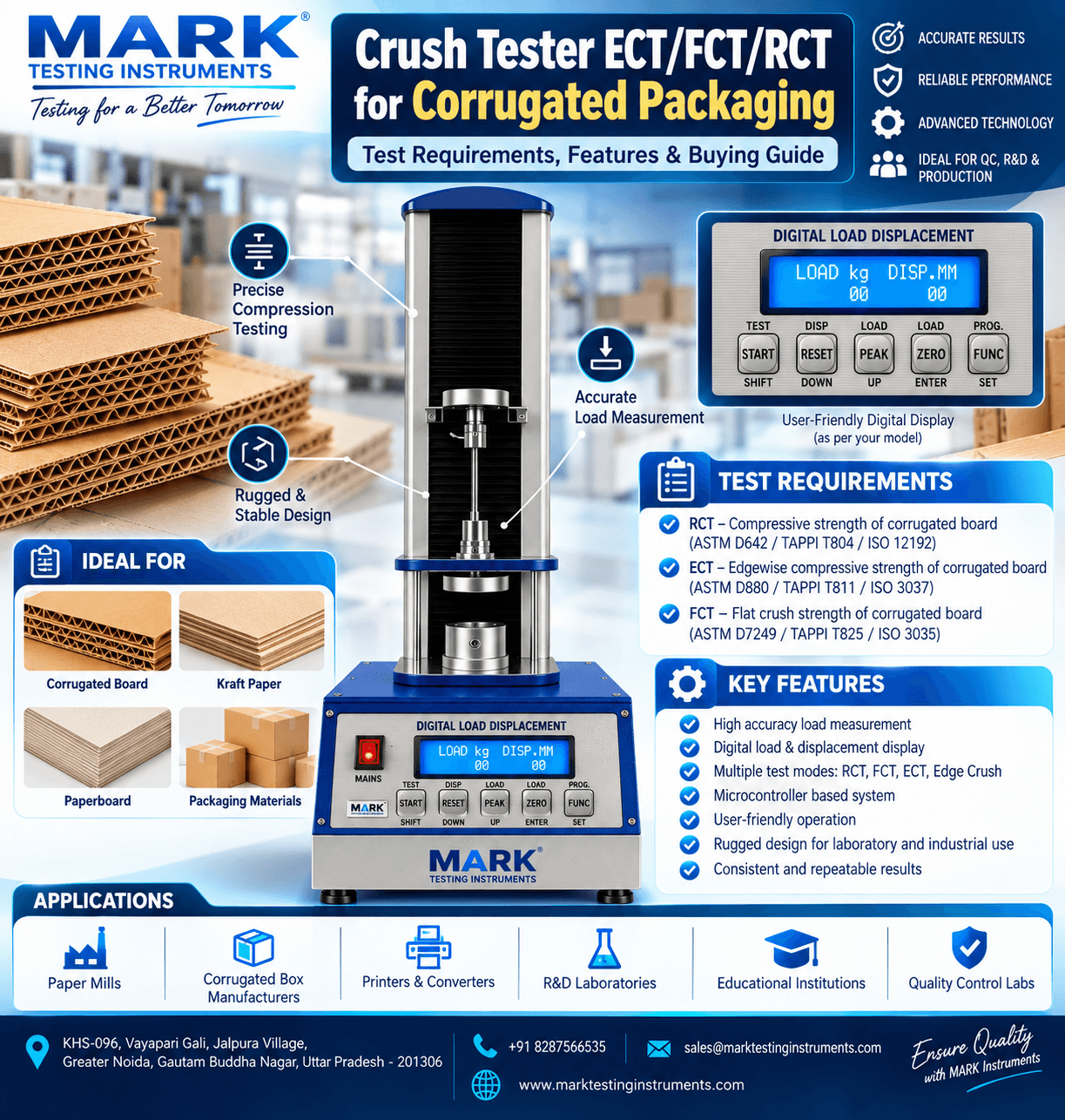
Explore how to select an ECT/FCT/RCT Crush Tester in India for corrugated packaging laboratories. Compare testing methods, capacity, accuracy, fixtures, Digital, Computerized and HMI configurations, calibration and buying considerations.
Crush Tester ECT/FCT/RCT for Corrugated Packaging: Test Requirements, Features & Buying Guide
Selecting the right Crush Tester ECT/FCT/RCT in India is important for corrugated box manufacturers, paper mills, packaging suppliers and quality-control laboratories.
A Crush Tester is used to evaluate the compressive resistance of suitable paper, paperboard and corrugated board specimens under controlled loading conditions.
Depending on the test fixture and applicable standard, the equipment can perform:
- Edge Crush Test (ECT)
- Flat Crush Test (FCT)
- Ring Crush Test (RCT)
These tests help manufacturers evaluate material strength, monitor production quality and compare packaging material specifications.
MARK Testing Instruments offers testing solutions for corrugated packaging laboratories, with configuration and fixtures selected according to the required test methods.
This guide explains ECT, FCT and RCT testing, equipment specifications, fixtures, automation and important purchasing considerations.
What Is an ECT/FCT/RCT Crush Tester?
An ECT/FCT/RCT Crush Tester is a compression testing instrument used with suitable specimen holders and fixtures to determine specific compression properties of paper and corrugated board.
The instrument applies a controlled compressive force while measuring the resistance offered by the specimen.
Different fixtures and sample preparation methods allow different tests to be performed.
The machine should be selected according to the required testing standard, expected load and specimen dimensions.
Understanding ECT, FCT and RCT Testing
1. Edge Crush Test (ECT)
The Edge Crush Test evaluates the edgewise compression resistance of corrugated board.
A suitable corrugated board specimen is positioned and compressed in the direction specified by the applicable test method.
ECT testing is widely used to assess corrugated board strength and support packaging design decisions.
Applications
- Corrugated board quality control
- Material grade comparison
- Incoming material inspection
- Packaging development
- Production monitoring
2. Flat Crush Test (FCT)
The Flat Crush Test evaluates the resistance of corrugated board flutes to compression applied perpendicular to the board surface.
It helps assess the compression resistance of the flute structure.
Applications
- Corrugated board manufacturing
- Flute quality evaluation
- Production consistency monitoring
- Board structure comparison
- Packaging material development
3. Ring Crush Test (RCT)
The Ring Crush Test evaluates the edgewise compression resistance of a suitable paper or paperboard strip formed into a ring using a dedicated fixture.
RCT testing is commonly used for evaluating linerboard and other suitable paperboard materials.
Applications
- Paper mill quality control
- Linerboard evaluation
- Paperboard grade comparison
- Incoming material inspection
- Production process monitoring
Difference Between ECT, FCT and RCT
| Parameter | ECT | FCT | RCT |
|---|---|---|---|
| Full Form | Edge Crush Test | Flat Crush Test | Ring Crush Test |
| Main Material | Corrugated Board | Corrugated Board | Paper / Paperboard |
| Measurement | Edgewise Compression Resistance | Flatwise Compression Resistance | Ring Compression Resistance |
| Specimen Setup | Edgewise Board Specimen | Flat Board Specimen | Paper Strip in Ring Fixture |
| Main Purpose | Corrugated Board Strength | Flute Compression Resistance | Paperboard Compression Resistance |
| Fixture | ECT Fixture | FCT Fixture | RCT Fixture |
These methods measure different properties and their results should not be treated as interchangeable.
Why Crush Testing Is Important for Corrugated Packaging
Corrugated packaging must provide sufficient strength for its intended application.
Crush testing helps manufacturers:
- Verify material specifications
- Compare paper and corrugated board grades
- Monitor production consistency
- Identify material variations
- Support packaging development
- Evaluate flute performance
- Investigate packaging quality problems
- Maintain quality-control documentation
Crush test results provide useful material-level information.
However, finished-box performance also depends on factors such as box design, dimensions, moisture condition and loading environment.
MARK Crush Tester — Important Features
When selecting a Crush Tester, evaluate the following features.
Digital Load Measurement
A digital measurement system provides load indication and peak-force measurement.
Controlled Compression
The loading system should provide the movement and test speed required by the selected test method.
Interchangeable Fixtures
ECT, FCT and RCT testing require different specimen preparation and holding arrangements.
Load Capacity
The instrument should have adequate capacity for the expected test loads.
Measurement Accuracy
Accuracy and resolution should be confirmed from the selected machine specification.
Test Data Reporting
Depending on configuration, reporting options may include:
- Digital result display
- Thermal printing
- Computer software
- Electronic test records
- HMI touchscreen operation
Calibration
Calibration requirements should be confirmed before purchasing.
Digital vs Computerized vs HMI Crush Tester
Different laboratories require different levels of automation.
Digital Crush Tester
Suitable for routine production quality control where direct compression-force measurement is required.
Digital Crush Tester with Printer
Suitable for laboratories requiring immediate physical test documentation.
Computerized Crush Tester
Suitable for laboratories requiring software-based operation, electronic reports and graphical analysis.
HMI Touchscreen Crush Tester
Suitable for laboratories requiring standalone touchscreen operation, programmable settings and additional data-management functions where provided.
Important: Availability of each configuration and its features must be confirmed against the final MARK model quotation.
Technical Specifications to Check Before Purchase
| Parameter | Selection Requirement |
|---|---|
| Instrument | ECT/FCT/RCT Crush Tester |
| Brand | MARK Testing Instruments |
| Testing Principle | Controlled Compression |
| Load Capacity | According to required test range |
| Load Resolution | Confirm for selected model |
| Load Accuracy | Confirm for selected model |
| Test Speed | As required by applicable method |
| Fixtures | ECT / FCT / RCT as ordered |
| Display | According to selected configuration |
| Printer | Optional, where available |
| Software | Optional, where available |
| Calibration | According to specified scope |
| Power Supply | Confirm for selected model |
| Warranty | 12 Months |
The exact capacity, speed, accuracy and fixture specifications should be included in the final technical quotation.
Applicable ECT, FCT and RCT Testing Standards
ISO 3037 — Edge Crush Testing
ISO 3037 addresses determination of edgewise crush resistance of corrugated fibreboard.
TAPPI T811 — Edge Crush Testing
TAPPI T811 covers edgewise compressive strength testing of corrugated fibreboard using the waxed-edge method.
ISO 12192 — Ring Crush Testing
ISO 12192 specifies a method for determining the ring crush resistance of paper and board.
ISO 3035 — Flat Crush Testing
ISO 3035 addresses determination of flat crush resistance of corrugated fibreboard.
TAPPI T825 — Flat Crush Testing
TAPPI T825 is another relevant flat crush method for corrugated board.
The applicable method must be selected according to the material, specimen preparation and customer specification.
How to Choose the Right Crush Tester in India
Step 1: Identify the Tests Required
Confirm whether the laboratory needs:
- ECT only
- FCT only
- RCT only
- ECT + FCT
- ECT + FCT + RCT
Step 2: Select the Applicable Standards
Confirm the test standards required by customers or the laboratory quality system.
Step 3: Determine Load Capacity
Estimate the expected compression loads for the materials being tested.
Step 4: Check Fixtures
Confirm that the quotation includes all required test fixtures.
Step 5: Verify Measurement Performance
Check:
- Load range
- Accuracy
- Resolution
- Test speed
- Calibration scope
Step 6: Select Reporting Features
Determine whether the laboratory needs:
- Digital results
- Printed reports
- Computerized reports
- Graphical analysis
- HMI touchscreen controls
Step 7: Review Service Requirements
Confirm warranty, calibration, technical support and spare-part requirements.
Crush Tester ECT/FCT/RCT Price in India
The price of a Crush Tester depends on several technical and commercial factors.
These include:
- Machine load capacity
- Measurement accuracy
- Compression mechanism
- ECT fixture
- FCT fixture
- RCT fixture
- Digital controller
- Printer
- Computer software
- HMI touchscreen
- Calibration documentation
- Installation requirements
A machine supplied with all three test fixtures and advanced reporting may have a different price from a basic Digital configuration.
Buyers should compare the complete equipment scope rather than the machine price alone.
Crush Tester for Noida and Delhi NCR
Corrugated packaging manufacturers and quality-control laboratories in Noida and Delhi NCR can select ECT/FCT/RCT testing equipment according to their material specifications and production requirements.
Before requesting a quotation, provide:
- Material type
- Required tests
- Applicable standards
- Expected compression load
- Required fixtures
- Reporting requirements
- Calibration requirements
Common Buying Mistakes
- Ordering without confirming the test method
- Assuming one fixture performs all three tests
- Selecting insufficient load capacity
- Ignoring test speed requirements
- Comparing display resolution with accuracy
- Forgetting calibration documentation
- Assuming all ECT methods use identical specimen preparation
- Choosing equipment based only on price
Frequently Asked Questions
What is the difference between ECT and RCT?
ECT measures edgewise compression resistance of corrugated board, while RCT measures ring compression resistance of suitable paper or paperboard.
What does FCT measure?
FCT measures flatwise compression resistance of corrugated board, primarily reflecting flute resistance under the specified method.
Can one Crush Tester perform ECT, FCT and RCT?
A suitably configured compression testing machine can perform these tests using the required fixtures, specimen preparation and test procedures.
Which standards are applicable?
Relevant methods include ISO 3037, TAPPI T811, ISO 12192, ISO 3035 and TAPPI T825.
What determines the price of a Crush Tester?
Price depends on load capacity, accuracy, fixtures, controller, reporting system, calibration and other configuration requirements.
Request a Crush Tester ECT/FCT/RCT Quotation
MARK Testing Instruments provides testing solutions for paper and corrugated packaging quality-control laboratories.
For model selection, send:
Material Type + Required Tests + Test Standards + Expected Load + Fixtures + Reporting Requirements
MARK Testing Instruments
Email: sales@marktestinginstruments.com
Website: www.marktestinginstruments.com