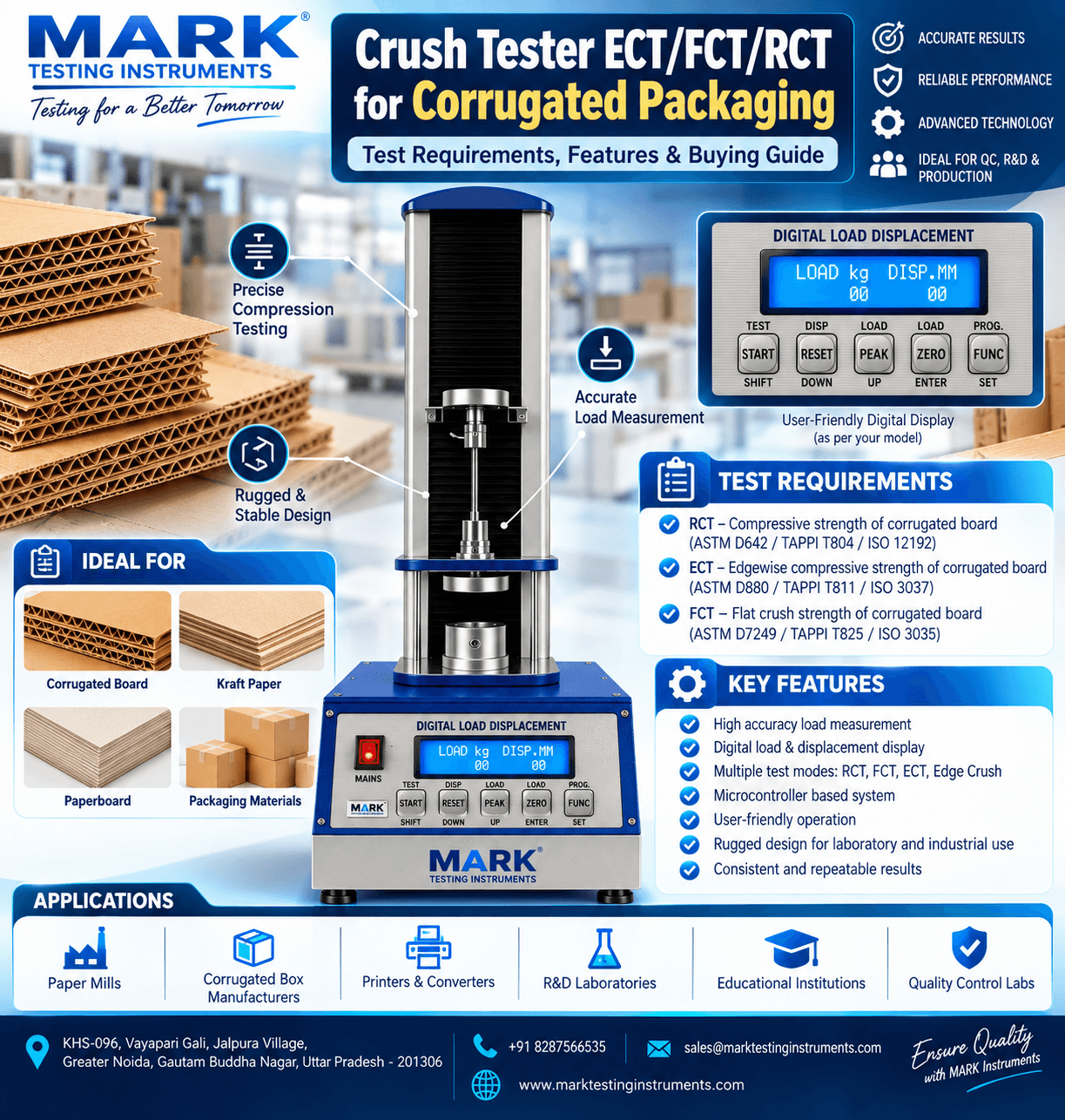
Crush Tester ECT/FCT/RCT Buying Guide: Capacity, Accuracy, Fixtures and Data Features
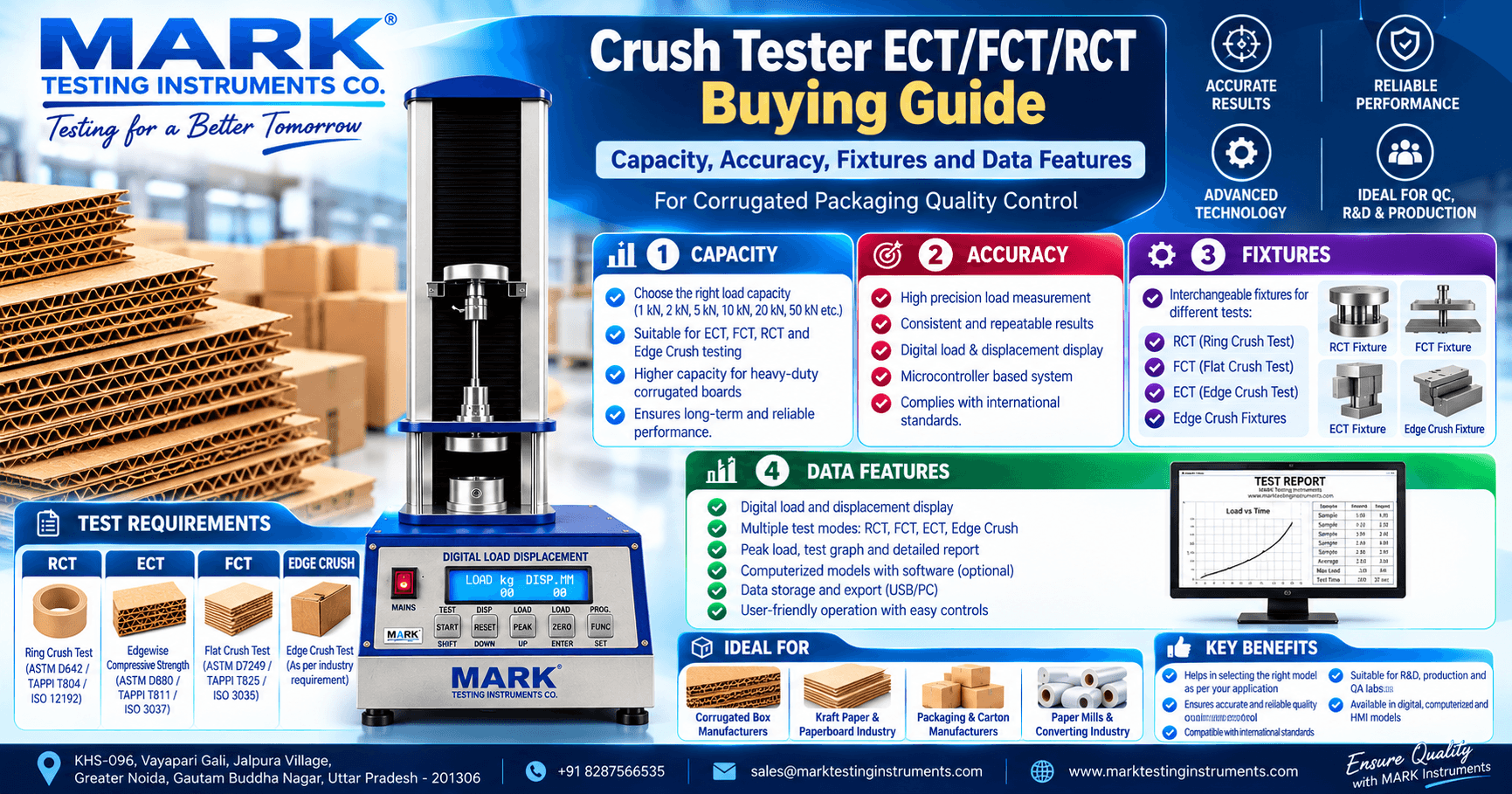
Technical buying guide for ECT, FCT and RCT Crush Testers covering load capacity, measurement accuracy, fixtures, testing standards, specimen preparation, calibration, data acquisition and reporting features.
Crush Tester ECT/FCT/RCT Buying Guide: Capacity, Accuracy, Fixtures and Data Features
An ECT/FCT/RCT Crush Tester is an important instrument for evaluating the compression properties of suitable paper, paperboard and corrugated fibreboard specimens.
The equipment applies controlled compressive loading and measures the resistance of the specimen.
Different test fixtures allow laboratories to evaluate different material properties.
Selecting the correct Crush Tester requires careful evaluation of load capacity, measurement accuracy, test speed, fixture geometry, specimen preparation and reporting requirements.
This technical guide explains the main considerations for modern corrugated packaging laboratories.
1. Working Principle of a Crush Tester
A Crush Tester uses a controlled loading mechanism to apply compression to a prepared specimen.
The specimen is positioned between compression surfaces or within a dedicated fixture.
As the load increases, the instrument measures the force applied to the specimen.
Depending on the test method, the result represents a specific compression property.
The testing system typically includes:
- Load measurement system
- Compression platens
- Mechanical frame
- Drive mechanism
- Controller
- Safety and limit functions
- Specimen fixtures
- Data display or reporting system
2. Edge Crush Test (ECT)
The Edge Crush Test evaluates edgewise compression resistance of corrugated board.
The test uses a prepared corrugated board specimen loaded in the specified direction.
Relevant Standards
- ISO 3037
- TAPPI T811
Important Considerations
- Specimen dimensions
- Edge preparation
- Test method
- Compression speed
- Specimen support
- Material conditioning
- Load measurement accuracy
Different ECT methods can require different specimen preparation and support arrangements.
3. Flat Crush Test (FCT)
The Flat Crush Test evaluates flatwise compression resistance of corrugated fibreboard.
The specimen is compressed perpendicular to the board surface.
Relevant Standards
- ISO 3035
- TAPPI T825
Important Considerations
- Specimen preparation
- Test area
- Compression platens
- Test speed
- Board flute structure
- Specimen conditioning
- Load measurement
FCT results help evaluate resistance of the corrugated flute structure to flatwise compression.
4. Ring Crush Test (RCT)
The Ring Crush Test evaluates compression resistance of a suitable paper or paperboard strip formed into a ring.
A dedicated ring holder supports the specimen during compression.
Relevant Standard
- ISO 12192
Important Considerations
- Specimen width
- Specimen thickness
- Ring fixture dimensions
- Material conditioning
- Compression speed
- Load measurement
The correct ring holder and specimen preparation are essential for reliable results.
5. ECT vs FCT vs RCT
| Parameter | ECT | FCT | RCT |
|---|---|---|---|
| Material | Corrugated Board | Corrugated Board | Paper / Paperboard |
| Loading Direction | Edgewise | Flatwise | Ring Compression |
| Main Property | Edge Crush Resistance | Flat Crush Resistance | Ring Crush Resistance |
| Fixture | ECT Support | Flat Crush Setup | Ring Holder |
| Typical Result | Force per Unit Length | Pressure / Force per Area | Force per Unit Length |
| Relevant Method | ISO 3037 | ISO 3035 | ISO 12192 |
Results and units must be reported according to the selected method.
6. Selecting Load Capacity
The Crush Tester must have sufficient capacity for the maximum expected test load.
Important considerations include:
- Material grade
- Specimen geometry
- Expected compression resistance
- Required test method
- Load-cell measurement range
- Overload protection
An excessively high-capacity system may not be the most appropriate choice for low-force testing.
The selected capacity should provide suitable measurement performance across the intended working range.
7. Measurement Accuracy and Resolution
Accuracy and resolution are different parameters.
Resolution
Resolution is the smallest increment displayed or recorded by the measurement system.
Accuracy
Accuracy describes the agreement of the measured value with a reference value under specified conditions.
Before purchasing, verify:
- Load measurement accuracy
- Resolution
- Calibration range
- Repeatability
- Measurement uncertainty where applicable
Do not assume that a smaller displayed increment guarantees higher accuracy.
8. Compression Speed and Control
Test speed can influence compression results.
The machine must provide the required loading conditions for the selected test method.
Important factors include:
- Crosshead or platen speed
- Speed stability
- Loading alignment
- Test termination
- Peak load detection
- Mechanical rigidity
The selected test standard should determine the required test conditions.
9. Importance of Test Fixtures
ECT, FCT and RCT use different specimen configurations.
ECT Fixture
Designed to support or position the corrugated board specimen according to the selected method.
FCT Fixture
Provides the required compression arrangement for flatwise loading.
RCT Fixture
Holds the paper or paperboard strip in the required ring configuration.
Fixtures should be selected according to the applicable standard.
A machine supplied without the required fixture may not be ready to perform the intended test.
10. Specimen Preparation
Reliable crush testing begins with correct specimen preparation.
Laboratories should verify:
- Specimen dimensions
- Cutting quality
- Edge condition
- Material conditioning
- Specimen orientation
- Absence of unintended damage
- Applicable standard requirements
Improper preparation can significantly influence test results.
11. Digital, Computerized and HMI Systems
Digital System
Suitable for routine compression testing and peak-force measurement.
Digital with Printer
Suitable for immediate physical test documentation.
Computerized System
Can support:
- Electronic results
- Load-versus-displacement graphs
- Test history
- Software-based reports
- Data export
HMI Touchscreen System
Can support:
- Touchscreen operation
- Test parameter entry
- Stored results
- User access
- Test profiles
- Printing on configured models
Exact features depend on the selected machine.
12. Data Acquisition and Reporting
Modern laboratories may require electronic records for quality-control analysis.
Possible report fields include:
- Test Number
- Date and Time
- Operator
- Sample Identification
- Material Grade
- Test Method
- Peak Load
- Calculated Result
- Unit
- Remarks
- Pass / Fail Criteria
Data acquisition should be evaluated according to the test speed, required measurement resolution and reporting requirements.
13. Calibration Requirements
Calibration supports reliable force measurement.
Important considerations include:
- Load measurement verification
- Calibration range
- Measurement traceability
- Compression speed verification where required
- Fixture inspection
- Mechanical alignment
- Preventive maintenance
Calibration documentation should identify the parameters and range covered.
14. Common Testing Problems
Inconsistent Results
Possible causes:
- Improper specimen preparation
- Incorrect conditioning
- Fixture misalignment
- Test speed variation
- Specimen damage
- Measurement system issues
Premature Specimen Failure
Possible causes:
- Damaged specimen edges
- Incorrect positioning
- Unsuitable fixture
- Material defects
Unexpectedly High or Low Results
Possible causes:
- Incorrect units
- Wrong test method
- Calibration issues
- Improper specimen dimensions
- Data calculation errors
15. Crush Tester Technical Selection Checklist
| Requirement | What to Verify |
|---|---|
| Test Methods | ECT / FCT / RCT |
| Standards | ISO / TAPPI as applicable |
| Load Capacity | Expected test loads |
| Accuracy | Specified measurement accuracy |
| Resolution | Suitable display increment |
| Test Speed | Method-specific requirement |
| Fixtures | Included and compatible |
| Specimen Preparation | Suitable cutters and holders |
| Data Reporting | Digital / Printer / Computerized / HMI |
| Calibration | Scope and traceability |
| Power Supply | Installation requirement |
| Technical Support | Service and maintenance |
16. Selecting Equipment for International Laboratories
International buyers should confirm:
- Required test standards
- Electrical supply
- Load capacity
- Fixtures
- Calibration documentation
- Operating manuals
- Export packing
- Software compatibility
- Installation and training requirements
- Spare-part availability
Laboratories in the UAE and other international markets should specify the actual test methods before equipment selection.
Frequently Asked Questions
Can the same Crush Tester perform ECT, FCT and RCT?
Yes, if the machine is designed for the required loading conditions and equipped with the correct fixtures.
Why are different fixtures required?
Each method uses a different specimen geometry and loading arrangement.
Is ECT the same as RCT?
No. ECT evaluates corrugated board, while RCT evaluates ring compression resistance of suitable paper or paperboard.
Why is calibration important?
Calibration helps verify that the load measurement system performs within its specified requirements.
Is a Computerized Crush Tester better than a Digital model?
A Computerized system offers additional data features, but the correct choice depends on the laboratory's requirements.
Conclusion
Selecting the right ECT/FCT/RCT Crush Tester requires more than comparing machine capacity or display features.
The key selection factors are:
Test Method → Material → Load Capacity → Accuracy → Test Speed → Fixtures → Data Reporting → Calibration
A correctly configured testing system helps laboratories maintain consistent testing procedures and reliable quality-control records.
MARK Crush Testing Solutions
MARK Testing Instruments provides testing solutions for paper, paperboard and corrugated packaging quality-control laboratories.
For technical selection and quotation, provide the required test methods, standards, expected loads and reporting requirements.
Email: sales@marktestinginstruments.com
Website: www.marktestinginstruments.com