What Affects Coefficient of Friction Tester Test Results? A Practical Guide for Indian QC Teams
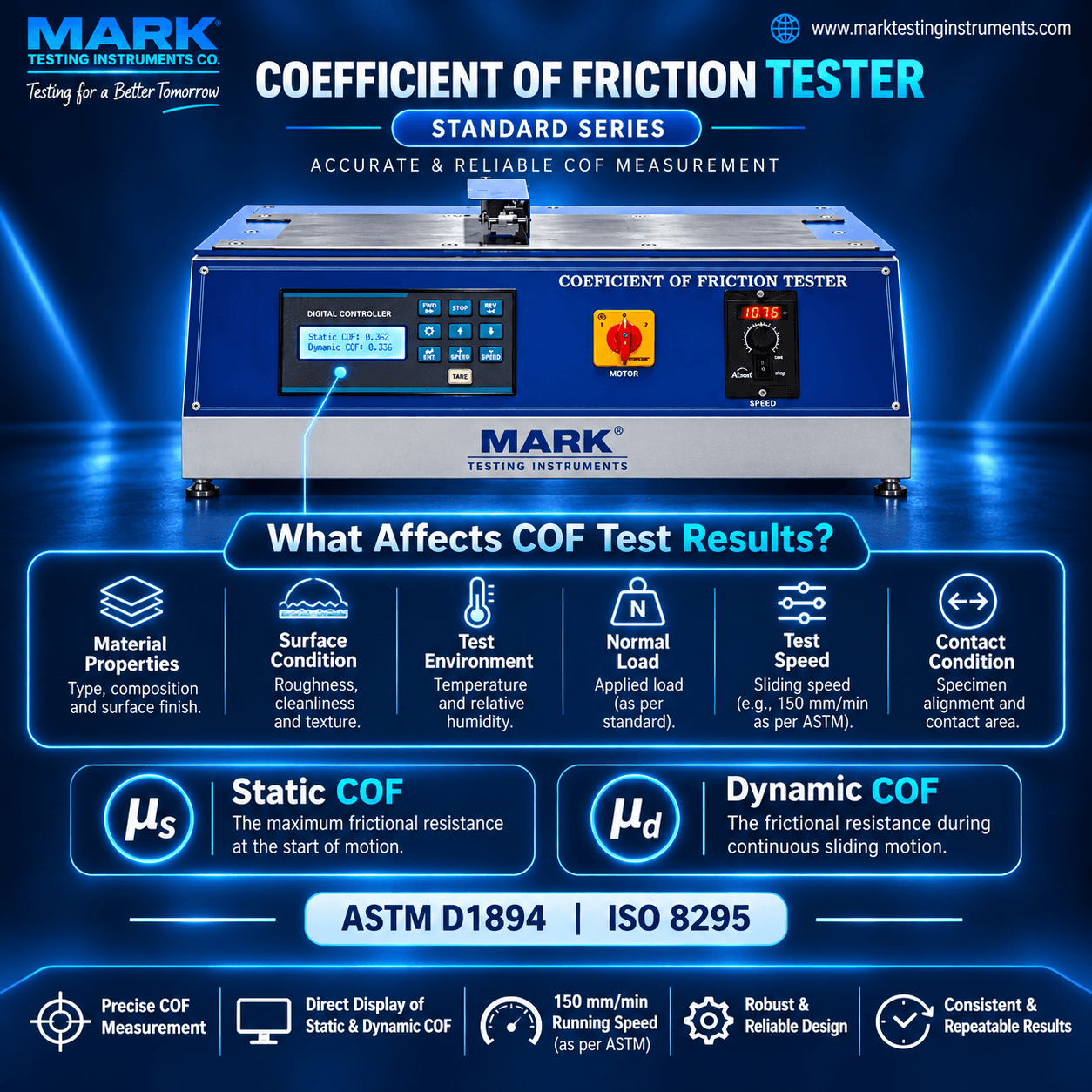
Understand the factors affecting static and dynamic coefficient of friction test results in plastic films and flexible packaging. Learn about sample conditioning, surface contamination, test speed, sled weight, calibration, ASTM D1894, ISO 8295 and how to improve COF testing accuracy in Indian quality-control laboratories.
What Affects Coefficient of Friction Tester Test Results? A Practical Guide for Indian QC Teams
The Coefficient of Friction (COF) is an important surface property of plastic films, flexible packaging materials and other suitable sheet products.
For Indian packaging manufacturers, controlling friction characteristics helps maintain consistent material movement during converting, printing, laminating, filling, sealing and packaging operations.
A film with unsuitable friction properties may create problems during production, including inconsistent feeding, poor stacking, difficult film separation or unwanted slippage.
A Coefficient of Friction Tester measures the resistance between two contacting surfaces under specified testing conditions.
However, COF results can vary because of sample preparation, environmental conditions, surface contamination, test speed, sled configuration and machine performance.
MARK Testing Instruments offers Digital, Computerized, HMI and HMI-cum-Computerized COF Testing Machines for flexible packaging quality-control laboratories.
This guide explains the main factors affecting COF results, common testing errors and practical methods for improving measurement consistency.
What Is the Coefficient of Friction?
The coefficient of friction describes the relationship between frictional force and the normal force acting between contacting surfaces.
It is expressed as:
Coefficient of Friction (μ) = Frictional Force / Normal Force
Because the coefficient is a ratio of two forces, it is dimensionless.
COF testing commonly evaluates two properties:
Static Coefficient of Friction
Static COF describes resistance to the initiation of sliding movement between contacting surfaces.
It is associated with the force required to begin relative motion.
Dynamic Coefficient of Friction
Dynamic COF, also called kinetic COF, describes resistance during continued sliding movement.
The values are determined according to the applicable test procedure.
Why COF Testing Is Important for Flexible Packaging
Friction characteristics can influence material handling and machine performance.
COF testing supports:
- Flexible packaging film development
- Film-to-film friction evaluation
- Film-to-metal friction evaluation
- Material grade comparison
- Slip additive evaluation
- Production quality control
- Incoming material inspection
- Packaging machine performance investigations
- Quality consistency monitoring
For packaging manufacturers, COF testing provides measurable information that can help investigate processing problems.
1. Sample Surface Condition
Surface condition is one of the most important factors influencing COF results.
A film surface may contain:
- Dust
- Oil
- Moisture
- Processing residues
- Surface scratches
- Contamination
- Handling marks
These conditions can alter friction behaviour.
Recommended Practice
Use clean, representative specimens and avoid touching the test surface unnecessarily.
Follow the specimen preparation requirements of the selected test method.
2. Temperature and Humidity
Environmental conditions can affect the surface behaviour of some materials.
Changes in temperature or humidity may influence:
- Surface moisture
- Material flexibility
- Adhesion between contacting surfaces
- Friction characteristics
- Test repeatability
Recommended Practice
Condition specimens according to the selected standard and maintain suitable laboratory conditions during testing.
Record environmental conditions when required.
3. Test Speed
Sliding speed can influence the measured dynamic friction behaviour.
An unsuitable or inconsistent speed may produce results that are difficult to compare.
MARK COF Tester
Selected MARK configurations use a test speed of 150 mm/min.
The required speed should always be checked against the selected test method and machine configuration.
Recommended Practice
Verify that the machine speed matches the approved laboratory procedure.
4. Sled Weight and Normal Force
The sled applies the normal force between contacting surfaces.
If the sled mass differs from the specified requirement, the normal force will change.
Because COF is calculated from friction force divided by normal force, an incorrect sled mass or incorrect normal-force value can affect the result.
Recommended Practice
- Verify the sled mass
- Use the correct sled configuration
- Ensure proper specimen attachment
- Confirm the normal-force value used in calculations
5. Contact Surface and Test Pairing
COF results depend on the two surfaces being tested.
Common combinations include:
- Film against film
- Film against metal
- Film against another specified substrate
The same film may produce different friction values when tested against different surfaces.
Recommended Practice
Always identify both contacting materials in the test record.
Do not compare results obtained from different surface combinations without considering the test conditions.
6. Film Direction and Surface Orientation
Plastic films may have different surface characteristics on their two sides.
For example, treated and untreated surfaces can behave differently.
The orientation of the specimen may also be relevant to the material and testing objective.
Recommended Practice
Identify the test side and specimen orientation before testing.
Maintain consistent specimen positioning across the test series.
7. Slip Additives and Surface Treatments
Slip additives are used in certain plastic film formulations to modify surface friction.
Their effectiveness can depend on:
- Additive concentration
- Film formulation
- Processing conditions
- Time after production
- Storage conditions
- Surface treatment
Recommended Practice
Compare specimens under consistent conditioning and storage conditions.
For materials containing migrating slip additives, consider the time elapsed after production when interpreting results.
8. Sample Wrinkles and Uneven Contact
Wrinkles, folds and poor specimen attachment can change the contact conditions.
Possible consequences include:
- Irregular friction force
- Unstable graph
- Inconsistent results
- Premature specimen movement
Recommended Practice
Mount the specimen smoothly and follow the fixture preparation procedure.
Avoid stretching or damaging the film during installation.
9. Force Measurement Accuracy
The load measurement system must be suitable for the expected friction force.
Important parameters include:
- Force measurement range
- Resolution
- Accuracy
- Calibration status
- Repeatability
A machine with a high display resolution is not automatically accurate across its entire measurement range.
Recommended Practice
Confirm that the calibration covers the forces used during routine testing.
10. Sled Alignment and Mechanical Condition
Improper alignment can introduce additional resistance or uneven loading.
Possible causes include:
- Misaligned pulling mechanism
- Damaged sled
- Worn contact surfaces
- Mechanical obstruction
- Incorrect specimen mounting
Recommended Practice
Inspect the sled, pulling arrangement and test surface before operation.
ASTM D1894 and ISO 8295
ASTM D1894 — Static and Kinetic Coefficients of Friction of Plastic Film and Sheeting
ASTM D1894 addresses determination of static and kinetic coefficients of friction of plastic film and sheeting.
ISO 8295 — Plastics: Film and Sheeting — Determination of the Coefficients of Friction
ISO 8295 specifies a method for determining coefficients of friction of plastic film and sheeting.
These standards should be applied within their respective scopes.
Important: Although both standards address COF testing, their specimen arrangements and procedural requirements should not be assumed to be identical.
Step-by-Step COF Testing Procedure
Step 1: Identify the Test Method
Select ASTM D1894, ISO 8295 or another suitable method.
Step 2: Prepare the Specimens
Cut and prepare specimens according to the selected standard.
Step 3: Condition the Material
Condition specimens as required by the method.
Step 4: Inspect the Tester
Check the sled, contact surface, pulling system, load measurement and calibration status.
Step 5: Select the Test Parameters
Enter or confirm:
- Test method
- Test speed
- Normal force
- Specimen identification
- Surface combination
- Reporting settings
Step 6: Mount the Specimen
Position the material correctly on the sled and test surface.
Step 7: Start the Test
Begin movement according to the approved test procedure.
Step 8: Record Static COF
Determine static friction according to the selected method.
Step 9: Record Dynamic COF
Determine dynamic friction using the prescribed evaluation procedure.
Step 10: Review the Results
Check for unusual force variation, specimen movement or invalid test conditions.
Common COF Testing Problems
Problem: Inconsistent Results
Possible Causes
- Surface contamination
- Different specimen orientation
- Conditioning differences
- Sled alignment
- Test speed variation
Corrective Actions
- Standardize preparation
- Verify specimen orientation
- Check the sled
- Follow conditioning requirements
- Verify test speed
Problem: Unexpectedly High COF
Possible Causes
- Surface contamination
- Incorrect contacting surfaces
- Material formulation changes
- Surface treatment differences
- Mechanical resistance
Corrective Actions
- Inspect specimens
- Confirm test pairing
- Check the mechanical system
- Compare material batches
Problem: Unexpectedly Low COF
Possible Causes
- Slip additive variation
- Surface contamination by lubricating substances
- Incorrect normal-force calculation
- Material surface changes
Corrective Actions
- Review material history
- Verify sled mass
- Confirm surface conditions
- Check calculations
Problem: Irregular Force Graph
Possible Causes
- Wrinkled specimens
- Improper attachment
- Mechanical vibration
- Sled movement problems
Corrective Actions
- Prepare a new specimen
- Check mounting
- Inspect the tester
- Repeat the test
MARK Coefficient of Friction Tester Configurations
Digital COF Tester
Suitable for routine static and dynamic friction testing.
Computerized COF Tester
Suitable for laboratories requiring electronic data, graphical analysis and reporting.
HMI Touchscreen COF Tester
Suitable for standalone touchscreen operation and structured test settings.
HMI-cum-Computerized COF Tester
Combines HMI operation and computer-based functionality on the selected configuration.
The available features depend on the specific model.
Technical Specifications to Confirm Before Purchase
| Parameter | Selection Requirement |
|---|---|
| Instrument | Coefficient of Friction Tester |
| Brand | MARK Testing Instruments |
| Test Properties | Static and Dynamic COF |
| Test Speed | 150 mm/min on selected models |
| Standards | ASTM D1894 / ISO 8295 |
| Sled Mass | As required by selected method |
| Force Range | According to configuration |
| Force Accuracy | Confirm for selected model |
| Display | Digital / HMI / Computerized |
| Graph | Selected Computerized / HMI models |
| Printer | Where configured |
| Data Storage | Model dependent |
| Calibration | According to required scope |
Final specifications must be confirmed in the technical quotation.
COF Tester Price in India
The price of a Coefficient of Friction Tester depends on:
- Force measurement range
- Accuracy
- Drive system
- Sled and test fixtures
- Digital controller
- HMI touchscreen
- Computer software
- Graphical reporting
- Printer
- Calibration documentation
- Installation requirements
Buyers should compare the complete testing configuration rather than price alone.
COF Tester for Ahmedabad and Gujarat
Flexible packaging manufacturers and quality-control laboratories in Ahmedabad and Gujarat can evaluate MARK COF Testing Machines for plastic films, laminates and other suitable materials.
Before requesting a quotation, provide:
- Material type
- Contacting surfaces
- Required standard
- Expected COF range
- Required test speed
- Digital, HMI or Computerized preference
- Reporting requirements
- Calibration requirements
Frequently Asked Questions
What is the difference between static and dynamic COF?
Static COF describes resistance to the initiation of sliding, while dynamic COF describes resistance during continued sliding.
Which standards are used for plastic film COF testing?
ASTM D1894 and ISO 8295 are commonly relevant to plastic film and sheeting COF testing.
Does humidity affect COF results?
Environmental conditions can influence the friction behaviour of some materials and should be controlled according to the selected method.
Why are COF results inconsistent?
Possible causes include surface contamination, specimen preparation differences, test speed variation, alignment and conditioning.
Is a Computerized COF Tester available?
Yes. MARK offers Computerized COF Tester configurations.
Is an HMI model available?
Yes. MARK offers HMI Touchscreen COF Tester configurations.
Request a Coefficient of Friction Tester Quotation
MARK Testing Instruments offers Digital, Computerized, HMI and HMI-cum-Computerized COF Testing Machines for flexible packaging quality-control laboratories.
For model selection, send:
Material + Contacting Surfaces + Standard + Required COF Range + Reporting Requirements
MARK Testing Instruments
Email: sales@marktestinginstruments.com
Website: www.marktestinginstruments.com