How to Choose a Universal Testing Machine for a Modern Quality Control Laboratory
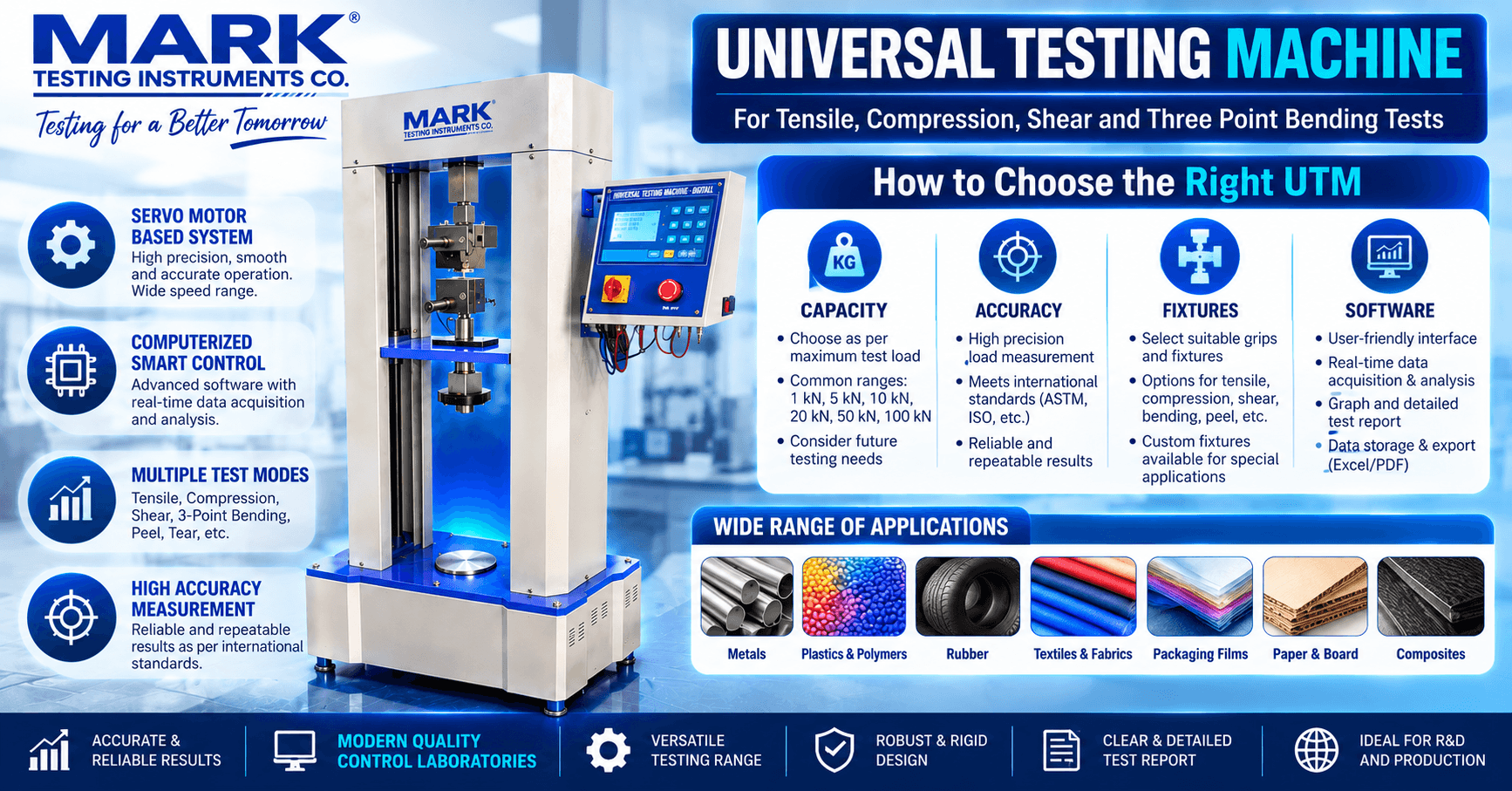
Technical guide to choosing a Universal Testing Machine for modern quality control laboratories. Compare load capacity, servo motor control, testing speed, accuracy, tensile and compression fixtures, bending tests, software, calibration and reporting.
How to Choose a Universal Testing Machine for a Modern Quality Control Laboratory
A Universal Testing Machine (UTM) is a fundamental instrument in modern mechanical and material testing laboratories.
It is used to evaluate how materials respond to controlled mechanical loading.
Depending on the installed fixtures and measurement systems, a UTM can perform tensile, compression, shear and flexural tests.
However, Universal Testing Machines vary significantly in capacity, accuracy, control system, available travel, testing speed, software and reporting capabilities.
Choosing the right configuration is essential for reliable testing and efficient laboratory operation.
This guide explains the main technical factors to consider when selecting a UTM.
1. Define the Laboratory Testing Requirements
Before selecting a machine, identify the tests that the laboratory must perform.
Possible applications include:
- Tensile strength testing
- Compression testing
- Shear testing
- Three-point bending
- Flexural strength testing
- Material deformation analysis
- Mechanical property evaluation
The machine must support the required loading conditions and specimen geometry.
2. Understand the Working Principle
A Universal Testing Machine applies controlled mechanical force or displacement to a specimen.
The machine typically includes:
- Structural load frame
- Moving crosshead
- Load measurement system
- Drive mechanism
- Controller
- Specimen grips
- Compression or bending fixtures
- Safety systems
- Software or display
During testing, the controller moves the crosshead according to the selected method.
The load cell measures the applied force.
Depending on the configuration, the machine records displacement, extension or strain.
3. Choose the Correct Load Capacity
Load capacity is one of the most important selection parameters.
The machine must have sufficient capacity for the maximum expected testing force.
Consider:
- Material strength
- Specimen dimensions
- Test method
- Expected peak load
- Load-cell working range
- Overload protection
A high-capacity machine is not automatically the best choice for low-force specimens.
For accurate testing, select a capacity and load cell suitable for the expected measurement range.
4. Evaluate Measurement Accuracy
Measurement accuracy affects the reliability of reported results.
Important parameters include:
- Force measurement accuracy
- Load resolution
- Calibration range
- Repeatability
- Measurement uncertainty
- Verification documentation
Accuracy vs Resolution
Resolution is the smallest increment displayed or recorded.
Accuracy describes how closely the measurement agrees with a reference value under specified conditions.
A machine with fine resolution is not necessarily more accurate.
5. Select the Drive System
Modern electromechanical UTMs can use different drive and control arrangements.
A servo motor-based UTM can provide controlled crosshead motion and programmable test conditions.
Important selection factors include:
- Speed control
- Motion stability
- Crosshead travel
- Mechanical rigidity
- Drive performance
- Control response
- Maintenance requirements
The drive system must be appropriate for the intended test methods.
6. Check Testing Speed Range
Different materials and standards require different testing speeds.
The UTM must provide the required speed range and control performance.
Verify:
- Minimum speed
- Maximum speed
- Speed setting resolution
- Speed verification
- Crosshead movement stability
- Test termination functions
Do not assume one speed is suitable for all tensile and flexural tests.
7. Evaluate Crosshead Travel and Test Space
The machine must provide sufficient working space for:
- Specimen length
- Grip dimensions
- Compression fixtures
- Bending fixtures
- Expected specimen extension
- Test travel
A machine with insufficient travel may not accommodate the required specimen or test.
8. Choose the Correct Fixtures
A UTM can perform different tests only when equipped with suitable fixtures.
Tensile Grips
Used for holding specimens during tensile testing.
Compression Platens
Used for applying compressive loading.
Shear Fixtures
Used for specific shear testing methods.
Three-Point Bending Fixture
Used for supporting and loading specimens during flexural testing.
Fixture design and dimensions must follow the applicable standard.
9. Understand ASTM D638 and ASTM D790
ASTM D638
ASTM D638 addresses tensile properties of plastics.
Important parameters include:
- Specimen geometry
- Conditioning
- Testing speed
- Force measurement
- Strain measurement
- Result calculation
ASTM D790
ASTM D790 addresses flexural properties of suitable plastics and electrical insulating materials.
Important parameters include:
- Specimen dimensions
- Support span
- Loading nose geometry
- Test speed
- Deflection measurement
- Result calculation
The correct fixture and procedure must be used for each standard.
10. Select Suitable Strain Measurement
Some material properties require accurate specimen strain measurement.
Possible methods include:
- Contact extensometers
- Non-contact extensometers
- Other suitable strain measurement systems
Crosshead displacement includes contributions from machine and fixture compliance.
Therefore, crosshead travel should not automatically be treated as direct specimen strain.
11. Digital vs HMI vs Computerized UTM
Digital UTM
Suitable for straightforward mechanical testing where basic load measurement and operation are required.
HMI Touchscreen UTM
Suitable for standalone operation with touchscreen controls.
Depending on configuration, features may include:
- Test parameter entry
- Stored profiles
- Graphical display
- Data storage
- Thermal printing
- Password-controlled functions
Computerized UTM
Suitable for laboratories requiring advanced software-based testing.
Possible features include:
- Test method configuration
- Real-time force monitoring
- Load-versus-displacement graphs
- Electronic reports
- Result calculations
- Historical data storage
- Exportable results
12. MARK Computerized Smart Series UTM
MARK Testing Instruments offers a Computerized Smart Series Universal Testing Machine — Servo Motor Based.
The system is designed for controlled mechanical testing and computerized reporting.
Testing Capabilities
With suitable fixtures and configurations:
- Tensile testing
- Compression testing
- Shear testing
- Three-point bending testing
Main Features
- Servo motor drive
- Computerized control
- Load measurement system
- Variable testing speed
- Suitable grips and fixtures
- Real-time graphical display
- Electronic reporting
- Test data storage
- Safety functions
13. Technical Specifications
Selected MARK configurations include:
| Parameter | Specification |
|---|---|
| Series | Computerized Smart |
| Drive | Servo Motor Based |
| Standard Capacity | 100 kgf on selected configurations |
| Optional Capacity | Up to 5000 kgf |
| Load Readability | 0.01 kg on specified models |
| Stated Accuracy | ±0.05% on specified models |
| Traverse | 900 mm, customizable |
| Speed | Variable |
| Control | Computerized |
| Test Modes | Tensile / Compression / Shear / Bending |
| Software | Test Control and Reporting |
| Graph | Real-Time Load vs Displacement |
| Grips | As per specimen |
| Power Supply | 220 V AC, Single Phase, 50 Hz on specified configurations |
| Warranty | 12 Months |
Final specifications depend on the selected model and must be confirmed before ordering.
14. Software and Data Reporting
Modern laboratories may require detailed electronic test records.
Possible report fields include:
- Test Number
- Date and Time
- Operator
- Sample Identification
- Material
- Test Standard
- Specimen Dimensions
- Maximum Load
- Tensile Strength
- Compressive Strength
- Flexural Results
- Elongation
- Graphical Data
- Remarks
- Pass / Fail Criteria
The available calculations depend on the selected test method and measurement systems.
15. Calibration and Verification
A UTM should be evaluated for its calibration and verification requirements.
Important parameters include:
- Force measurement
- Testing speed
- Displacement measurement
- Strain measurement
- Fixture alignment
- Measurement traceability
Calibration scope should be appropriate to the laboratory's testing requirements.
16. Common UTM Selection Mistakes
- Selecting capacity without considering the actual force range
- Ignoring the required test standards
- Choosing unsuitable grips
- Overlooking bending fixture requirements
- Assuming all materials use the same testing speed
- Confusing resolution with accuracy
- Ignoring strain measurement requirements
- Failing to verify software reporting functions
- Overlooking calibration documentation
- Comparing machines only by price
17. Selecting a UTM for International Laboratories
International laboratories, including customers in the UAE, should confirm:
- Material type
- Test standards
- Required capacity
- Fixture requirements
- Measurement accuracy
- Software features
- Electrical compatibility
- Calibration documentation
- Installation requirements
- Training
- Technical support
- Spare parts
Frequently Asked Questions
What is the difference between a UTM and a Tensile Testing Machine?
A UTM can support multiple mechanical testing modes when suitably configured, while a dedicated tensile tester may be designed primarily for tensile loading.
Can a UTM perform compression testing?
Yes, when the machine has the appropriate capacity, control system and compression fixtures.
Can a UTM perform three-point bending?
Yes, with a suitable bending fixture and the required test procedure.
What is the advantage of a Computerized UTM?
Computerized systems can provide electronic reports, graphical analysis and test-data management.
Does ASTM D790 cover tensile testing?
No. ASTM D790 is a flexural testing method for suitable materials.
Conclusion
Choosing the correct Universal Testing Machine requires careful evaluation of the material, test method, force range, accuracy, speed, travel, fixtures and reporting requirements.
The recommended selection sequence is:
Material → Test Standard → Load Capacity → Accuracy → Speed → Travel → Fixtures → Software → Calibration
A properly configured UTM supports reliable testing and consistent laboratory documentation.
MARK Universal Testing Machine Solutions
MARK Testing Instruments offers Universal Testing Machines for material quality-control and research applications.
For technical selection and quotation:
Email: sales@marktestinginstruments.com
Website: www.marktestinginstruments.com