How Coefficient of Friction Tester Improves Quality Control in Paper Manufacturing
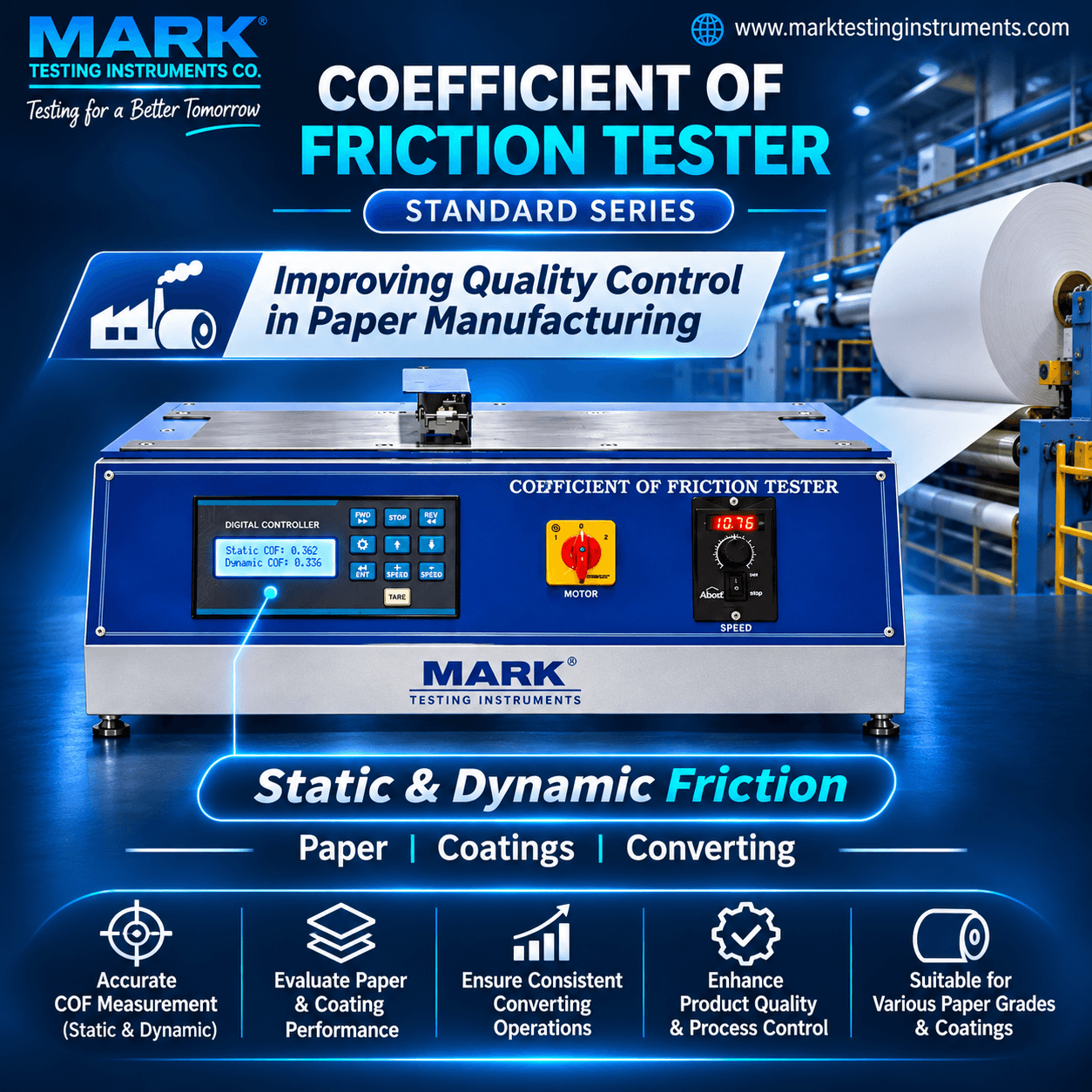
Explore how Coefficient of Friction testing supports quality control in paper manufacturing, printing, converting and packaging. Learn about static and dynamic friction, paper handling, test methods, specimen conditioning, equipment selection and data reporting.
How Coefficient of Friction Tester Improves Quality Control in Paper Manufacturing
Surface friction plays an important role in the handling, converting, printing, stacking and transportation of paper and paper-based packaging materials.
Paper manufacturers must maintain consistent material properties to support reliable downstream processing.
Variations in friction characteristics can contribute to sheet-feeding problems, inconsistent stacking, unwanted sliding and converting difficulties.
A Coefficient of Friction Tester measures resistance between contacting surfaces under specified testing conditions.
For paper manufacturers, appropriate friction testing provides useful information about material surface behaviour and production consistency.
This guide explains the role of COF testing in paper manufacturing, important test methods, equipment selection and practical quality-control applications.
What Is Coefficient of Friction in Paper Manufacturing?
The coefficient of friction describes the relationship between frictional force and normal force acting between two contacting surfaces.
It is expressed as:
μ = Frictional Force / Normal Force
The coefficient is dimensionless.
Paper friction can be evaluated between:
- Paper and paper
- Paper and a specified reference surface
- Paperboard and paperboard
- Coated paper surfaces
- Other defined surface combinations
The selected test method determines the appropriate specimen configuration and measurement procedure.
Static and Dynamic Coefficient of Friction
Static COF
Static COF describes resistance to the initiation of sliding movement.
It can be relevant to how paper sheets begin moving relative to one another.
Dynamic COF
Dynamic COF describes resistance during continued sliding.
It can provide useful information about the movement of paper surfaces during handling and converting.
Both properties may be relevant depending on the material and application.
Why Friction Matters in Paper Manufacturing
Paper products are frequently moved, stacked, fed, separated and transported.
Friction characteristics can influence these operations.
COF testing helps manufacturers evaluate:
- Surface consistency
- Sheet-to-sheet movement
- Material handling behaviour
- Coating performance
- Paperboard processing
- Production batch variation
- Converting performance
- Packaging material development
COF is one of several material properties that influence machine performance.
1. Improving Sheet Feeding Consistency
Paper sheets are often fed individually into printing, cutting or converting equipment.
Inconsistent surface friction can contribute to feeding difficulties.
Possible problems include:
- Multiple-sheet feeding
- Irregular sheet movement
- Difficulty separating sheets
- Inconsistent feeding performance
COF measurements can help investigate whether friction variation is contributing to these problems.
2. Supporting Printing and Converting Operations
Paper converting operations involve contact between paper surfaces and machine components.
Friction characteristics may influence:
- Material movement
- Sheet separation
- Surface contact
- Handling consistency
- Processing behaviour
COF testing can support material comparison and investigation of production variations.
3. Evaluating Coated Paper
Coatings can alter the surface properties of paper.
Different coatings may influence:
- Surface texture
- Sliding behaviour
- Contact characteristics
- Moisture response
- Friction consistency
COF testing helps compare the friction behaviour of coated and uncoated materials under defined conditions.
4. Improving Paperboard Handling
Paperboard is used in cartons, packaging and industrial applications.
Friction characteristics can influence stacking, feeding and handling.
COF testing may help evaluate:
- Paperboard surface consistency
- Coating changes
- Material grade differences
- Production variations
- Contact behaviour
The test method should be selected according to the paperboard material and intended application.
5. Monitoring Production Batch Consistency
Manufacturing conditions can affect paper surface properties.
Potential influences include:
- Raw-material variation
- Surface finishing
- Coating application
- Moisture content
- Calendering
- Storage conditions
COF testing can provide comparative measurements across production batches.
6. Static vs Dynamic COF in Paper Applications
| Parameter | Static COF | Dynamic COF |
|---|---|---|
| Measurement | Resistance to Initial Sliding | Resistance During Sliding |
| Application | Sheet Separation and Initial Movement | Continued Surface Movement |
| Important Factors | Surface Contact and Conditioning | Speed, Surface and Contact Conditions |
| Reporting | Method Dependent | Method Dependent |
The interpretation of results must follow the selected testing procedure.
Testing Standards for Paper and Plastic Films
ISO 15359 — Paper and Board
ISO 15359 is relevant to determination of static and kinetic coefficients of friction of paper and board using the horizontal plane method.
TAPPI T549 — Paper Friction
TAPPI T549 is a relevant method for coefficients of static and kinetic friction of uncoated writing and printing paper using a horizontal plane method.
ASTM D1894 — Plastic Film and Sheeting
ASTM D1894 addresses static and kinetic coefficients of friction of plastic film and sheeting.
ISO 8295 — Plastic Film and Sheeting
ISO 8295 addresses determination of coefficients of friction of plastic film and sheeting.
Important: ASTM D1894 and ISO 8295 should not automatically be treated as paper testing standards.
A COF Tester intended for paper applications must be evaluated for compatibility with the selected paper-specific method.
Working Principle of a COF Tester
A horizontal-plane COF testing system commonly includes:
- Test surface
- Sled or specimen holder
- Force measurement system
- Controlled movement mechanism
- Controller
- Data display or software
During testing, relative movement is produced between contacting surfaces.
The instrument measures the frictional force.
The coefficient of friction is calculated from the measured force and normal force according to the selected method.
Important Factors Affecting Paper COF Results
1. Paper Moisture
Paper is sensitive to environmental moisture.
Moisture variation can affect surface behaviour.
2. Surface Roughness
Surface texture influences contact between paper surfaces.
3. Coating
Coatings may alter friction behaviour.
4. Test Speed
The sliding rate can influence dynamic friction measurements.
5. Normal Force
The applied normal force must follow the selected method.
6. Specimen Conditioning
Conditioning helps maintain comparable test conditions.
7. Surface Orientation
The tested surfaces should be identified and kept consistent.
8. Surface Contamination
Dust, oil and handling residues can affect measurements.
Step-by-Step Paper COF Testing Procedure
Step 1: Select the Test Standard
Identify the paper-specific friction testing method required.
Step 2: Prepare Specimens
Cut specimens according to the selected standard.
Step 3: Condition the Material
Condition the paper according to the required laboratory procedure.
Step 4: Inspect the Test Surface
Ensure the contact surfaces are clean and suitable for testing.
Step 5: Configure the Tester
Set the required:
- Test speed
- Normal force
- Specimen configuration
- Test method
- Reporting parameters
Step 6: Mount the Specimens
Install the specimens without wrinkles or unintended damage.
Step 7: Start the Test
Perform the test according to the approved procedure.
Step 8: Record Static COF
Determine the static coefficient according to the method.
Step 9: Record Dynamic COF
Determine the kinetic coefficient according to the method.
Step 10: Review and Report Results
Document the relevant test conditions and results.
How COF Testing Supports Quality Control
Incoming Material Inspection
Compare paper grades and incoming batches.
Production Monitoring
Monitor friction consistency during manufacturing.
Product Development
Evaluate the effects of coatings and surface treatments.
Customer Specification Verification
Compare results with agreed material requirements.
Troubleshooting
Investigate handling and feeding problems where friction may be a contributing factor.
Digital vs HMI vs Computerized COF Tester
Digital COF Tester
Suitable for routine friction testing and direct result indication.
HMI COF Tester
Suitable for standalone touchscreen operation.
Computerized COF Tester
Suitable for electronic test reporting and graphical analysis.
HMI-cum-Computerized COF Tester
Combines touchscreen and computer-based functions on the configured model.
The selected system must also be compatible with the required paper testing method.
MARK Coefficient of Friction Tester
MARK Testing Instruments offers COF Testing Machines for suitable plastic film and packaging applications.
Selected configurations include:
- Digital COF Tester
- Computerized COF Tester
- HMI COF Tester
- HMI-cum-Computerized COF Tester
A selected MARK configuration uses a test speed of 150 mm/min.
For paper and paperboard applications, fixture suitability, normal force, speed range and test-method compatibility should be confirmed before ordering.
Technical Selection Checklist
| Parameter | Requirement |
|---|---|
| Material | Paper / Paperboard / Plastic Film |
| Test Standard | Appropriate Material-Specific Method |
| Static COF | As Required |
| Dynamic COF | As Required |
| Normal Force | According to Standard |
| Test Speed | According to Standard |
| Contact Surface | Defined Test Pair |
| Force Measurement | Suitable Range and Accuracy |
| Fixture | Method Compatible |
| Display | Digital / HMI / Computerized |
| Reporting | According to Laboratory Requirements |
| Calibration | Appropriate Scope |
Common Paper COF Testing Errors
Inconsistent Results
Possible causes:
- Moisture variation
- Surface differences
- Incorrect conditioning
- Test speed variation
- Specimen preparation errors
Unexpectedly High Friction
Possible causes:
- Surface contamination
- Coating variation
- Moisture differences
- Incorrect surface pairing
Unexpectedly Low Friction
Possible causes:
- Surface treatment variation
- Coating differences
- Incorrect normal force
- Specimen preparation problems
Irregular Force Graph
Possible causes:
- Wrinkled specimens
- Poor specimen mounting
- Mechanical vibration
- Surface irregularities
Frequently Asked Questions
Why is COF important in paper manufacturing?
Friction characteristics influence paper handling, feeding, separation and converting behaviour.
Can the same COF Tester test paper and plastic film?
A suitably configured machine may support both materials if the fixtures, test conditions and measurement capabilities meet the applicable methods.
Are ASTM D1894 and ISO 8295 paper testing standards?
No. They primarily address plastic film and sheeting.
Which standards are relevant to paper friction testing?
ISO 15359 and TAPPI T549 are examples of relevant methods, depending on the material and testing objective.
Does moisture affect paper COF?
Moisture can influence paper surface behaviour and should be controlled according to the selected procedure.
Conclusion
Coefficient of Friction testing helps paper manufacturers evaluate surface behaviour and investigate material-handling problems.
Reliable results depend on:
Material → Test Standard → Specimen Conditioning → Contact Surface → Normal Force → Speed → Measurement → Reporting
A properly selected COF Tester can support consistent quality-control procedures and material development.
MARK COF Testing Solutions
MARK Testing Instruments offers Digital, Computerized, HMI and HMI-cum-Computerized Coefficient of Friction Testers.
For paper-specific applications, contact the technical team to confirm the appropriate testing configuration.
Email: sales@marktestinginstruments.com
Website: www.marktestinginstruments.com