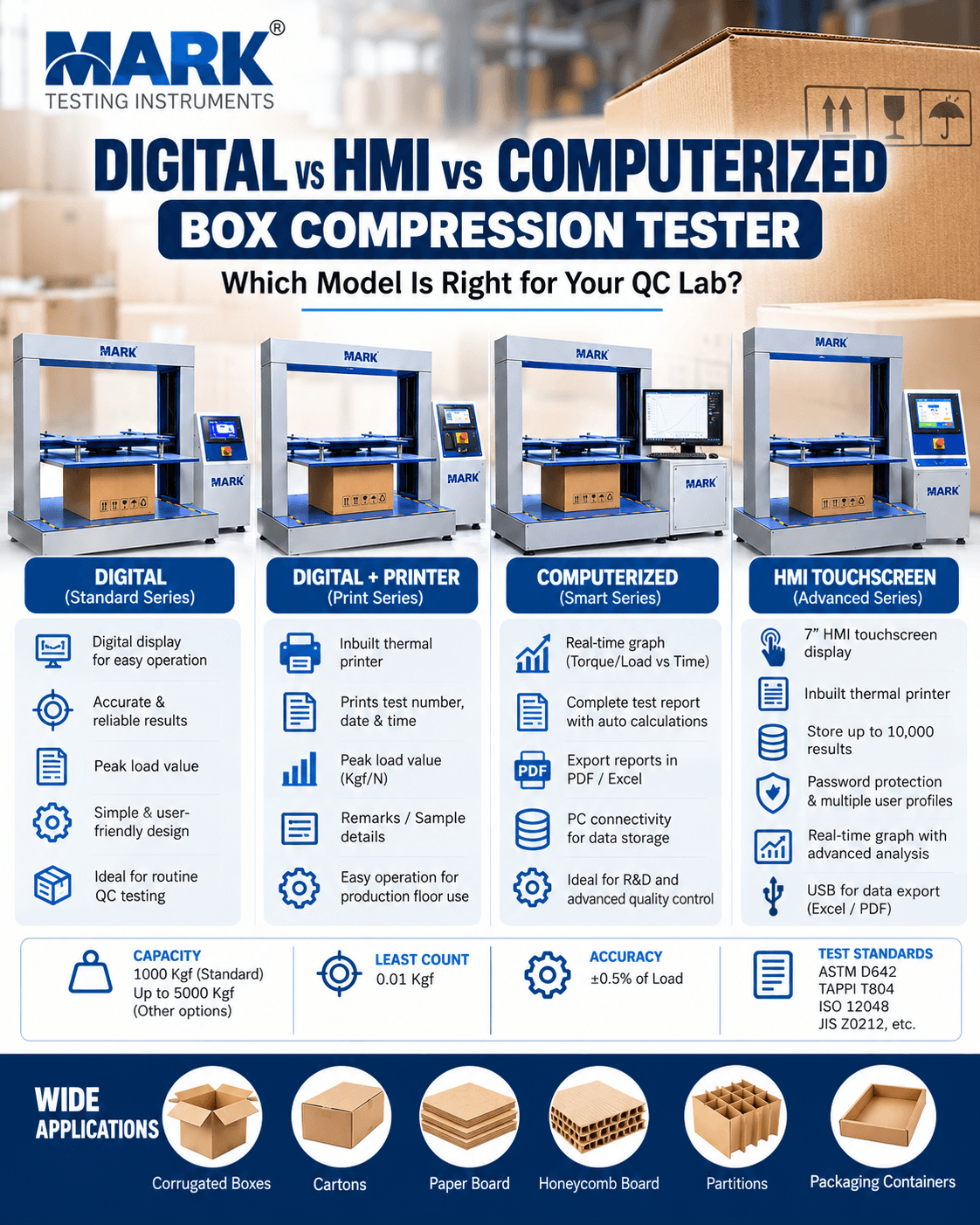
Digital vs HMI vs Computerized Box Compression Tester: A Technical Comparison
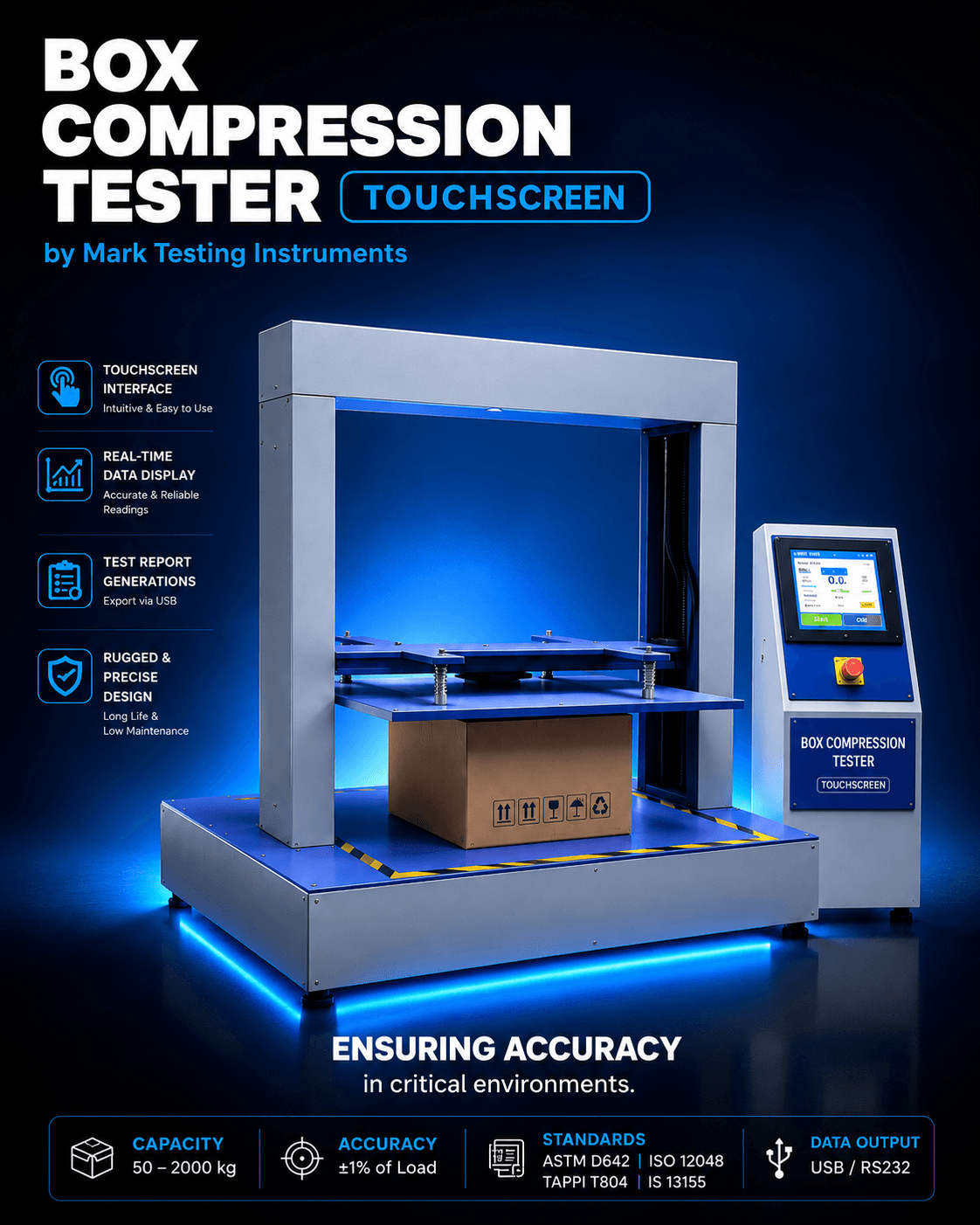
Technical comparison of Digital, HMI and Computerized Box Compression Testers covering compression measurement, loading, control systems, software, graphical analysis, calibration and reporting.
Digital vs HMI vs Computerized Box Compression Tester: A Technical Comparison
A Box Compression Tester (BCT) is used to evaluate the compressive resistance of corrugated boxes and suitable packaging containers.
Modern quality-control laboratories require accurate load measurement, controlled testing procedures and appropriate result documentation.
Although Digital, HMI and Computerized Box Compression Testers perform the same fundamental compression testing function, they differ in their control systems, data management, graphical analysis and reporting capabilities.
This guide explains the technical differences between these configurations.
1. Working Principle of a Box Compression Tester
During a typical compression test, a corrugated box is positioned between two compression platens.
A controlled compressive load is applied to the specimen.
The instrument measures the applied force throughout the test.
Depending on the selected test method and machine configuration, the test can determine:
- Maximum compression load
- Load at a specified deformation
- Compression behavior
- Load-versus-deformation relationship
- Failure characteristics
2. Main Components
A typical Box Compression Tester consists of:
- Compression platens
- Load measurement system
- Structural frame
- Loading mechanism
- Drive and control system
- Operator interface
- Safety and limit functions
- Reporting system, depending on model
3. Digital Box Compression Tester
A Digital Box Compression Tester provides direct control for routine compression testing.
Functions
- Digital load indication
- Peak load detection
- Test start and stop
- Load monitoring
- Test-result display
Advantages
- Straightforward operation
- Suitable for repetitive QC
- Does not require a separate computer
- Practical for production environments
4. Digital Box Compression Tester with Printer
A printer-equipped model provides immediate physical test records.
Reports can include:
- Test Number
- Date
- Time
- Peak Load
- Sample Details
- Remarks
The exact report format depends on the configuration.
5. HMI Touchscreen Box Compression Tester
An HMI system provides touchscreen-based instrument operation.
Depending on the selected model, features can include:
- Touchscreen interface
- Test parameter entry
- Peak load measurement
- Stored test information
- Operator access controls
- Data storage
- Thermal printing
HMI systems are useful for laboratories requiring standalone automation.
6. Computerized Box Compression Tester
Computerized systems use dedicated software for operation, analysis and reporting.
Features
- Computer interface
- Real-time load monitoring
- Load-versus-deformation graphs
- Electronic test records
- Report generation
- Historical test data
- Exportable results
- Software-based test management
7. Technical Comparison
| Parameter | Digital | HMI | Computerized |
|---|---|---|---|
| Operator Interface | Digital Controls | Touchscreen | Computer Software |
| Peak Load Measurement | Yes | Yes | Yes |
| Test Parameter Entry | Basic | Advanced | Software-Based |
| Thermal Printing | Printer Variant | Printer Variant | Configured Printing |
| Data Storage | Model Dependent | Model Dependent | Software Dependent |
| Graphical Analysis | Limited | Model Dependent | Available |
| Electronic Reports | Limited | Configuration Dependent | Available |
| Computer Required | No | No | Generally Yes |
| Typical Application | Routine QC | Advanced Standalone QC | Detailed QC & R&D |
8. MARK Box Compression Tester Technical Specifications
| Parameter | Specification |
|---|---|
| Standard Capacity | 1000 Kgf |
| Optional Capacity | Up to 5000 Kgf |
| Least Count | 0.01 Kgf on specified models |
| Accuracy | ±0.5% on specified models |
| Display | Digital / HMI / Computerized |
| Printer | Selected Variants |
| Software Reporting | Computerized Models |
| Sample Dimensions | According to Machine Size |
| Warranty | 12 Months |
9. Applicable Testing Standards
ASTM D642
Compressive resistance testing of shipping containers, components and unit loads.
ISO 12048
Compression and stacking tests for complete, filled transport packages.
TAPPI T804
Compression testing of fibreboard shipping containers.
These methods differ in scope and procedure.
10. Measurement Accuracy and Calibration
Laboratories should evaluate:
- Load-cell capacity
- Measurement accuracy
- Resolution
- Calibration range
- Mechanical alignment
- Test-speed control
- Measurement repeatability
Display resolution alone does not establish measurement accuracy.
11. Loading and Test-Speed Control
Important considerations include:
- Required platen movement
- Applicable test speed
- Maximum specimen dimensions
- Compression space
- Load capacity
- Safety limits
The machine should be evaluated against the selected testing standard.
12. Load-versus-Deformation Graph
Computerized configurations can provide graphical analysis.
A load-versus-deformation graph can help evaluate:
- Initial loading behavior
- Progressive deformation
- Maximum compression load
- Post-peak behavior
- Differences between box designs
13. Test Data and Reporting
Depending on the model, reports may include:
- Sample Identification
- Batch Number
- Test Number
- Operator
- Date and Time
- Maximum Load
- Test Method
- Specimen Dimensions
- Remarks
- Pass / Fail Criteria
14. Selecting a Box Compression Tester for UAE Laboratories
International buyers, including laboratories in the UAE, should evaluate:
- Electrical requirements
- Test standards
- Calibration documentation
- Export packing
- User manuals
- Software compatibility
- Technical support
- Installation requirements
- Spare parts
The final model should be selected according to the laboratory's actual testing requirements.
15. Model Selection Guide
| Requirement | Suggested Configuration |
|---|---|
| Routine Peak Load Testing | Digital |
| Physical Test Reports | Digital with Printer |
| Standalone Touchscreen Operation | HMI |
| Touchscreen with Printer | HMI with Printer |
| Graphical Analysis | Computerized |
| Electronic Reporting | Computerized |
Frequently Asked Questions
Is an HMI Box Compression Tester more accurate than a Digital model?
Not necessarily. Accuracy depends on the measurement and mechanical system, not simply the display type.
Why choose a Computerized model?
Computerized systems are useful for graphical analysis, electronic reporting and historical test-data management.
Can one machine test different box sizes?
Yes, provided the samples fit the machine's platen and compression-space limitations.
Are ASTM D642 and ISO 12048 identical?
No. Their scope and procedures differ.
Conclusion
Digital, HMI and Computerized Box Compression Testers share the same fundamental testing purpose but provide different control and reporting capabilities.
The correct selection process is:
Test Standard → Expected Load → Sample Dimensions → Measurement Requirements → Control System → Reporting → Calibration
MARK Box Compression Testing Solutions
MARK Testing Instruments offers Digital, Printer, HMI and Computerized Box Compression Tester configurations.
Email: sales@marktestinginstruments.com
Website: www.marktestinginstruments.com